


Software to Find Insurance for Self-Pay: 2026 RCM Guide
- FrontRunnerHC

- 3 hours ago
- 12 min read
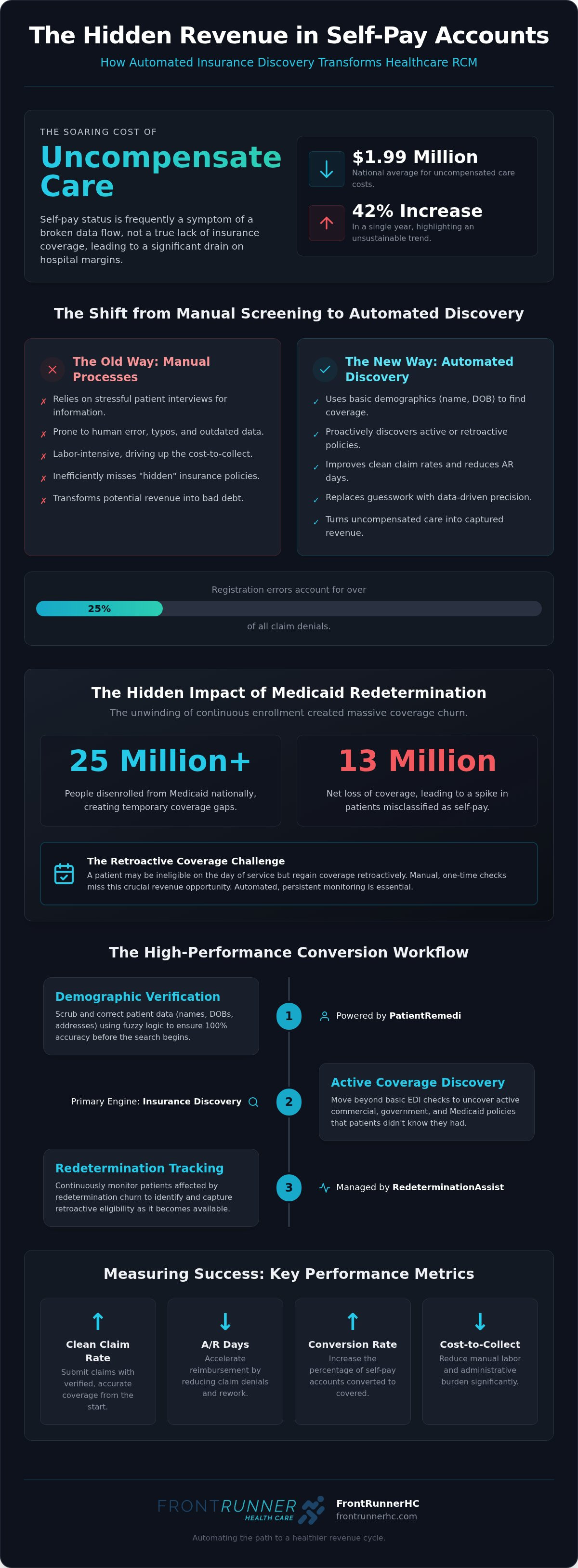
Did you know the national average for uncompensated care costs recently surged to $1.99 million, marking a staggering 42 percent increase in a single year? It's a crushing reality for revenue cycle leaders. You're likely grappling with the fallout of Medicaid redeterminations and an influx of accounts labeled as self-pay that should be covered. Relying on manual processes often means missing hidden coverage, but the right software to find insurance for self-pay patients changes the equation by uncovering active policies using only basic demographics like name and date of birth.
Conversion is fundamentally a data problem, not a patient interview problem. This guide explores how automated tools like PatientRemedi and RedeterminationAssist identify hidden Medicaid coverage and streamline the redetermination process. You'll learn how to leverage Insurance Discovery as your primary engine to capture revenue previously lost to uncompensated care, improve your clean claim rates, and finally reduce those stubborn AR days. It's time to move beyond the chaos of manual screening and embrace a more precise, automated path to reimbursement that protects your organization's bottom line.
Table of Contents
The High Cost of Uncompensated Care: Why Self-Pay is Often a Data Error
Uncompensated care isn't just a line item. It's a symptom of a broken data flow. In 2023, the national average uncompensated care cost reached $1.99 million, representing a staggering 42 percent increase over the previous year. For hospital margins in 2026, this drain is unsustainable. Many patients currently classified as self-pay actually possess active or retroactive Medicaid coverage. They simply don't know it, and your front-end staff can't see it. This disconnect transforms potential revenue into bad debt. Effective Revenue Cycle Management (RCM) requires a shift in perspective. Self-pay status is frequently a failure of data, not a lack of insurance.
The reality is that registration errors and eligibility issues account for over 25 percent of all claim denials. When a patient arrives without a card, the default shouldn't be "uninsured." It should be "unverified." Using advanced software to find insurance for self-pay patients allows providers to move beyond the limitations of the patient interview. It uncovers the coverage that exists beneath the surface of inaccurate demographic entries.
The Hidden Impact of Medicaid Redetermination
The recent unwinding of continuous enrollment has created a massive wave of coverage churn. Nationally, over 25 million people were disenrolled from Medicaid. While many eventually re-enrolled, the net result was a loss of coverage for 13 million individuals. This churn creates temporary gaps that manual systems fail to track. A patient might be ineligible on the day of service but qualify for retroactive coverage just weeks later. These gaps lead to a heavy administrative burden and a spike in denied claims. Success in 2026 depends on managing patient coverage gaps after medicaid redetermination through persistent, automated monitoring rather than one-time checks.
The Financial Drain of Manual Financial Counseling
Manual financial counseling is expensive and inefficient. It relies on the patient's ability to provide perfect information during a stressful clinical encounter. Often, patient-reported data is incomplete or outdated. Your staff spends hours chasing leads that go nowhere. This labor-intensive process drives up the cost-to-collect while missing the "hidden" insurance that software to find insurance for self-pay patients can identify in seconds. Moving from asking to discovering is the only way to scale. Automation like PatientRemedi and RedeterminationAssist replaces guesswork with precision. It ensures your team focuses on high-value tasks instead of manual data entry that's prone to human error.
How Modern Conversion Tools Automate Medicaid Eligibility Discovery
Managing uncompensated care costs requires more than just asking the patient for their card. It requires a proactive, data-driven approach that searches for coverage where others see a dead end. Modern software to find insurance for self-pay patients transforms the traditional manual interview into an automated discovery engine. This shift from asking to discovering allows providers to identify active policies that patients themselves may not realize they have, particularly in the complex landscape of retroactive Medicaid eligibility.
From Demographic Scrubbing to Active Discovery
The success of any insurance search depends entirely on the quality of the input data. If a name is misspelled or a birth date is transposed, traditional clearinghouse checks will fail. Demographic scrubbing is the foundation of conversion accuracy. By using PatientRemedi, providers can automatically fix these errors before the discovery process even begins. This technology utilizes fuzzy logic to identify patients even when addresses are outdated or names are slightly off. This ensures that the search is conducted against the most accurate patient identity possible, significantly increasing the hit rate for hidden coverage.
The automated workflow follows a logical, four-step progression to maximize recovery:
Step 1: Demographic Verification. Ensure the patient's identity is 100 percent accurate by scrubbing and correcting stale data points.
Step 2: Real-Time Insurance Discovery. Execute deep-dive searches across thousands of payers using only minimal data like name and date of birth.
Step 3: Advanced Insurance Eligibility Verification. Confirm the specific plan details, active coverage dates, and benefit limits to ensure the claim will be paid.
Step 4: Financial Disposition. Apply intelligent logic to prioritize accounts with the highest recovery potential, allowing your team to focus their efforts where they matter most.
Real-Time vs. Batch Discovery Workflows
Efficiency in the revenue cycle is often a matter of timing. Real-time discovery at the point of service allows registrars to address coverage issues while the patient is still present. This reduces the burden on front-end staff and prevents the "self-pay" label from being applied incorrectly at the start. In contrast, batch processing is an essential tool for Accounts Receivable Clean-Up. It allows organizations to run large volumes of older accounts through the discovery engine to find retroactive coverage that may have been granted after the initial encounter.
Both workflows are necessary to maintain a healthy bottom line. Automating these processes through Insurance Discovery reduces the risk of human error and ensures that no potential revenue is left on the table. If you're looking to streamline these complex workflows, exploring automated data remediation solutions can provide the clarity and speed your team needs to succeed. By moving away from manual registration checks, you can prevent future claim denials and ensure a more predictable cash flow.
Essential Features of High-Performance Conversion Platforms
High-performance conversion platforms do more than just check boxes. They serve as a specialized defense against rising uncompensated care costs. While basic EDI clearinghouse checks might catch obvious coverage, they often fail to look deep enough. A robust software to find insurance for self-pay patients utilizes proprietary discovery engines that search across thousands of payers simultaneously. This isn't just about speed; it's about the depth of the search. It's about uncovering that one retroactive Medicaid policy that a standard check would miss.
Finding the right software to find insurance for self-pay patients means looking for tools that provide deep integration with your existing EHR and RCM systems. Data must flow seamlessly without manual intervention to prevent administrative bottlenecks. These platforms offer user-friendly dashboards that provide a real-time view of conversion metrics and ROI. You shouldn't have to guess if your automation is working. You should be able to see the exact dollar amount of found coverage at any moment, allowing for better financial forecasting and resource allocation.
Medicaid Redetermination Assistance Capabilities
In 2026, the administrative fallout from the Medicaid unwinding remains a significant hurdle for providers. Utilizing specific medicaid redetermination assistance software is no longer optional; it's a requirement for financial stability. Many patients lose coverage not because they're ineligible, but because of paperwork errors or missed deadlines. RedeterminationAssist automates the process of identifying these individuals. It monitors coverage status changes over the long term, ensuring that when a patient's Medicaid is reinstated, your team is notified immediately. This persistent monitoring captures revenue that would otherwise be lost to coverage churn.
Financial Disposition and AR Prioritization
Not every self-pay account is recoverable. Logic-based financial disposition tools help your team separate true self-pay accounts from those with high Medicaid potential. This prioritization is essential for efficient Accounts Receivable Clean-Up. Instead of staff wasting time on accounts with no hope of reimbursement, the software guides them toward high-value tasks. By automatically cleaning up accounts where coverage is found, you reduce the noise in your AR. This focus accelerates cash flow and ensures that your limited administrative resources are applied where they'll have the greatest impact. It's about working smarter, not harder, to capture every possible cent of earned revenue.
Measuring Success: Key Metrics for Self-Pay to Medicaid Workflows
Implementing software to find insurance for self-pay patients is a strategic investment. To justify that investment, you need to track the right data. Metrics translate software performance into financial clarity. They show exactly how much revenue is being reclaimed from the void of uncompensated care. Without clear KPIs, you're flying blind. With them, you can demonstrate a direct impact on the organization's fiscal health. High-performance teams focus on four primary indicators to evaluate their conversion success.
Conversion Rate. This is your ultimate proof point. It measures the percentage of accounts initially labeled as self-pay that are successfully converted to active Medicaid.
Time to Conversion. Speed is critical for cash flow. This metric tracks the duration from the initial patient encounter to the moment coverage is identified and verified.
Uncompensated Care Reduction. Quantify the shift in your balance sheet. Track the total dollar value moved from the "write-off" category into active reimbursement.
Clean Claim Rate Improvement. Data remediation at the front end prevents errors at the back end. Improving this rate directly reduces the administrative cost of rework.
The Cost-to-Collect Ratio
Manual screening is a massive resource sink. It's slow, inconsistent, and prone to human error. Every hour your staff spends on manual patient interviews increases your overhead. Reducing manual touches lowers the cost-to-collect by minimizing the labor hours required to identify and verify coverage. Automation allows your team to focus on complex cases while the software handles the heavy lifting of discovery. This trend of leveraging technology to simplify complex, high-stakes paperwork is also helping individuals in other fields; for example, those who wish to find out more about managing their own residency applications without professional consultants. Recovering hidden insurance before an account hits a collections agency provides a massive ROI. It saves the high commission fees associated with external agencies and keeps more revenue within your system.
Data Integrity and Denial Prevention
Long-term billing accuracy depends on the quality of your inputs. Stale or incorrect demographic data is the leading cause of "coverage not found" denials. Utilizing healthcare data remediation software ensures that patient information is verified and corrected in real-time. This proactive approach significantly impacts your long-term financial stability. By measuring the reduction in denials over time, you can see the direct benefit of automated verification. Clean data means fewer returned mail pieces and more predictable reimbursement cycles. It's about building a foundation of accuracy that supports every subsequent step in the revenue cycle.
Ready to see these metrics improve in your own organization? Learn how our Insurance Discovery engine uncovers coverage that manual processes and basic clearinghouse checks miss.
Optimizing Your Revenue Cycle with FrontRunnerHC Solutions
In the current environment, your organization needs a partner that understands the nuance of revenue recovery. Many vendors offer software to find insurance for self-pay patients, but few bridge the gap between administrative chaos and financial order. FrontRunnerHC isn't a debt collection agency. It's a strategic data partner. We focus on recovering revenue through accuracy, not through aggressive patient billing. We don't perform Direct Patient Debt Collection. Instead, we use Insurance Discovery to uncover the coverage that already exists. This no-nonsense approach prioritizes finding existing policies that your team might've missed due to stale demographic data or complex Medicaid rules.
A national, automated approach is necessary for 2026 healthcare organizations. Manual processes can't keep pace with the scale of data churn. By leveraging Financial Disposition logic, our platform helps you prioritize accounts with the highest recovery potential. This ensures your team spends their time on accounts that'll actually result in reimbursement, rather than chasing unrecoverable self-pay debt. It's about maximizing efficiency while maintaining a compassionate approach to patient financial responsibility.
The PatientRemedi Difference
PatientRemedi serves as the single source of truth for your entire enterprise. It fixes fragmented data by automating remediation at the start of the patient journey. When every patient record is complete and verified, the entire billing process accelerates. Accuracy at the point of entry leads to faster reimbursement at the end. By scrubbing data against national databases, PatientRemedi ensures that your software to find insurance for self-pay patients is working with the most reliable identity information available. This enterprise-wide accuracy reduces the risk of returned mail and ensures that every claim is built on a foundation of verified demographic data.
Implementing RedeterminationAssist for Long-Term Stability
Medicaid revenue shouldn't be volatile. RedeterminationAssist allows you to proactively manage the Medicaid lifecycle for your specific population. It provides consistent, automated monitoring that flags status changes before they become denials. This long-term stability is essential for organizations facing the ongoing fallout of the Medicaid unwinding. By leveraging Insurance Discovery as your primary engine, you can clean up your AR and maintain a predictable cash flow. It's time to stop guessing and start discovering coverage with a partner that values precision over guesswork.
Secure Your Organization's Financial Future in 2026
The landscape of uncompensated care is shifting rapidly. Manual processes simply can't keep up with the current rate of coverage churn. You've seen how the right software to find insurance for self-pay patients moves beyond simple patient screening to active, automated discovery. By fixing fragmented data at the source and tracking the entire Medicaid lifecycle, you can stop the drain of bad debt write-offs. It's about moving from a state of administrative chaos to one of financial precision.
FrontRunnerHC provides the tools needed for this transition. With PatientRemedi, you ensure enterprise-wide data accuracy, while RedeterminationAssist automates coverage tracking for thousands of patients simultaneously. Our platform offers nationwide coverage for all major payers and Medicaid programs, providing the depth you need to uncover hidden policies. It's time to replace guesswork with a precision-driven approach that values your team's time and your organization's bottom line. Optimize Your Revenue Recovery with FrontRunnerHC today and start reclaiming the revenue your facility has already earned.
Frequently Asked Questions
What is the difference between Medicaid screening and Medicaid discovery?
Medicaid screening is a passive identification process, while discovery is an active search for existing coverage. Screening typically relies on patient interviews and manual questionnaires to identify potential eligibility based on self-reported data. In contrast, Medicaid discovery uses an automated engine to search payer databases for policies that the patient may not even realize they have. This proactive approach uncovers coverage that manual screening misses, especially when dealing with retroactive eligibility or recently reinstated policies.
How do self-pay to Medicaid conversion tools integrate with my current EHR?
High-performance software to find insurance for self-pay patients integrates directly with your existing EHR and RCM systems through secure APIs or HL7 interfaces. This ensures a seamless data flow where patient information is automatically scrubbed and verified without manual intervention. By embedding discovery workflows into your current registration screens, your team can access real-time insurance data without toggling between multiple applications. This integration significantly reduces administrative friction and speeds up the reimbursement cycle for every encounter.
Can these tools find coverage if the patient does not have their Medicaid ID?
Yes, advanced discovery tools can identify active coverage using only minimal data points like a patient's legal name and date of birth. You don't need the physical Medicaid card or the specific member ID to initiate a search. The software cross-references this demographic information against thousands of national and state-specific payer databases. This capability is vital for emergency department encounters or situations where patients arrive without documentation but possess active or retroactive coverage.
How has Medicaid redetermination affected self-pay conversion rates in 2026?
Medicaid redetermination has caused significant coverage churn, leading to a surge in accounts incorrectly labeled as self-pay. In 2026, providers see higher volumes of patients who have lost coverage for administrative reasons rather than eligibility changes. This has made automated discovery more critical than ever for financial health. While churn initially lowers immediate conversion rates, using a persistent monitoring tool like RedeterminationAssist allows providers to capture revenue the moment a patient’s coverage is reinstated or retroactively applied.
Do conversion tools help with retroactive Medicaid eligibility discovery?
Absolutely, as retroactive Medicaid discovery is a core function of modern insurance discovery engines. Many patients qualify for coverage that spans 90 days prior to their application date. If an encounter occurred during that window, the software identifies the retroactive policy even if it wasn't active on the date of service. This allows your billing department to convert older self-pay accounts into paid claims, effectively cleaning up your accounts receivable and recovering revenue previously lost.
What is the typical ROI for implementing an automated insurance discovery tool?
The ROI for implementing automated insurance discovery is typically realized through increased cash collections and reduced labor costs. By converting even a small percentage of high-dollar self-pay accounts to Medicaid, organizations often cover the software's cost within the first few months. Additionally, reducing the manual cost-to-collect by automating demographic verification and eligibility checks provides long-term operational savings. Most providers see a reduction in AR days and a boost in clean claim rates across the enterprise.
Is demographic verification necessary for successful Medicaid conversion?
Demographic verification is the essential foundation for successful Medicaid conversion. If a patient’s name is misspelled or their address is outdated, discovery searches will return "no coverage found" even if a policy exists. Using PatientRemedi to scrub and correct these errors ensures that your search is conducted against a 100 percent accurate identity. This precision significantly increases your hit rate, prevents returned mail, and ensures that found coverage is correctly mapped to the patient record.
Does FrontRunnerHC perform direct patient debt collection services?
No, FrontRunnerHC doesn't perform direct patient debt collection services. Our focus is strictly on data remediation and insurance discovery. We empower healthcare organizations to find active coverage and verify patient information so they can bill insurance companies directly. By identifying third-party payers, we help you avoid the need for aggressive patient collection tactics. Our goal is to resolve self-pay accounts through accurate data and discovered insurance rather than seeking payment directly from the patient.


Comments