


Reducing Healthcare Claim Denials: 2026 Data-First Guide
- FrontRunnerHC

- 2 days ago
- 11 min read
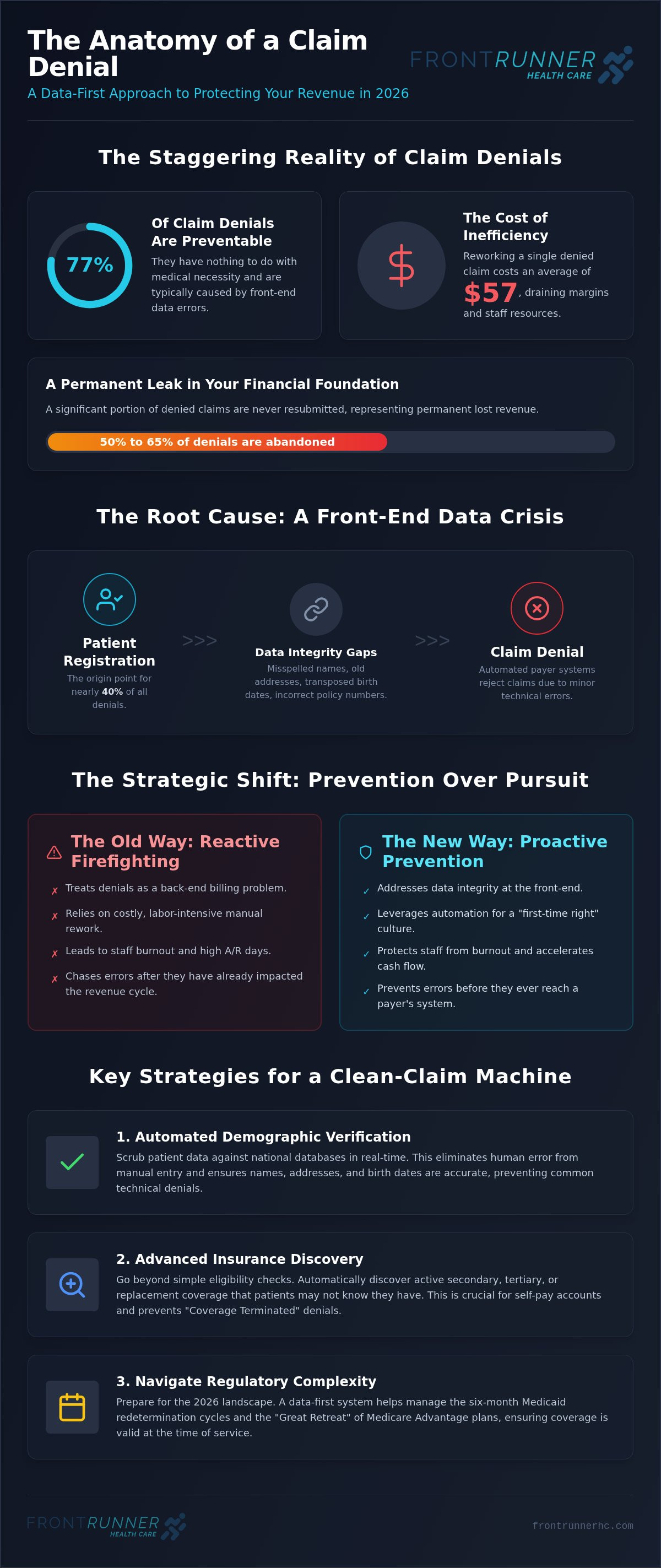
Did you know that 77% of your claim denials have absolutely nothing to do with medical necessity? It's a staggering reality for 2026. Most revenue leakage is born at the registration desk, long before a provider even sees the patient. You're likely exhausted by the endless cycle of manual data entry and the shifting goalposts of payer rules. It's frustrating to watch your staff burn out while the cost to rework a single claim has climbed to an average of $57. To truly reduce healthcare claim denials, you must stop chasing errors and start preventing them through a data-first strategy.
This guide will show you how to transform your revenue cycle from a reactive firefighting unit into a proactive, clean-claim machine. We'll explore how automated demographic verification and advanced insurance discovery can slash your days in AR and protect your bottom line. You'll learn to navigate the complexity of six-month Medicaid redetermination cycles and the "Great Retreat" of Medicare Advantage plans with precision. It's time to move beyond denial management and embrace a future where data integrity ensures you get paid for the vital work you do.
Table of Contents
The 2026 Landscape: Why Healthcare Claim Denials Are Rising
The administrative burden on healthcare providers has reached a tipping point. In 2026, the average hospital loses $5 million annually to denials, a figure that continues to climb as payer algorithms become more aggressive. It's no longer just about clerical errors. Payers are leveraging machine learning to scrutinize every line item, leading to automated rejections that feel like a "black box" to billing teams. When these systems create a De facto denial by complicating the appeals process until it's no longer cost-effective to pursue, your revenue cycle suffers. Relying on manual intervention to reduce healthcare claim denials is a losing battle in an era of chronic labor shortages. Staff burnout is at an all-time high. The "hidden cost" of these friction points is a degraded patient experience that damages your brand and erodes trust before a patient even enters the exam room.
The Economic Toll of Reworking Claims
Reworking a single claim now costs an average of $57. For a small practice, this drains margin; for a large system, it's a systemic failure. Perhaps most alarming is that between 50% and 65% of denied claims are never resubmitted. This isn't just lost revenue; it's a permanent leak in your financial foundation. High denial rates correlate directly with increased days in A/R, starving your organization of the cash flow needed for clinical innovation. When claims sit in limbo, the cost of collection often exceeds the reimbursement itself, forcing providers to write off millions in preventable losses. A foundational shift in data management is required to reduce healthcare claim denials and restore financial health.
Payer Complexity in the Post-Pandemic Era
The 2026 regulatory environment has introduced unprecedented friction. With the "Great Retreat" of Medicare Advantage insurers from specific counties and the shift toward more restrictive HMO plans, eligibility is a moving target. Technical denials, often triggered by minor demographic discrepancies like a missing middle initial or an outdated zip code, now account for a significant portion of rejections. Static eligibility checks performed days before an appointment are no longer sufficient. The shift to six-month Medicaid redetermination cycles starting December 31, 2026, means patient coverage can vanish overnight. You need real-time data accuracy to navigate these shifts without sacrificing your revenue cycle integrity.
Front-End Data Remediation: The First Line of Defense
Many organizations treat denials as a back-end billing failure. In reality, it's a data integrity crisis. Data remediation is the strategic process of identifying and correcting patient errors before they ever reach a payer's system. Industry data suggests that 30% to 40% of all denials are born at the registration desk. A misspelled name, an outdated address, or a transposed digit in a birth date can trigger an immediate rejection. To effectively reduce healthcare claim denials, providers must move beyond reactive corrections and implement a "first-time right" culture. While you can always appeal a health insurance decision, the administrative labor required is often more expensive than the original claim value. Prevention is the only sustainable path to profitability.
Automating Demographic Verification
Manual data entry is the enemy of accuracy. Automated demographic verification ensures that patient records are accurate and up-to-date, forming the bedrock of a clean claim. By scrubbing names, addresses, and dates of birth against authoritative national databases, you eliminate the friction of human error. This isn't just about basic spell-checking. It's about sophisticated identity management that reconciles fragmented records into a single source of truth. When your front-end data is bulletproof, you prevent the technical rejections that stall your revenue cycle. High-volume registration environments don't have the luxury of manual double-checks; they need automated systems that work at the speed of the patient encounter.
Real-Time Eligibility Assurance
A simple "active or inactive" eligibility check is no longer enough for the 2026 landscape. You need eligibility assurance. This requires a deep data dive to uncover secondary and tertiary coverage that the patient might not even realize they have. Identifying these policies at the point of service prevents the "Coverage Terminated" denials that plague the back-end. Integrating these automated workflows directly into your existing EHR or LIS environment allows your staff to work with confidence rather than guesswork. It transforms the registration process from a data entry task into a strategic financial encounter. If your team is struggling to keep up with shifting payer rules, leveraging Demographic Verification tools can provide the clarity needed to stop denials before they happen. This shift in focus protects your revenue and ensures that your clean claim rate remains high despite increasing industry complexity.
By treating patient data as a high-value asset, you can reduce healthcare claim denials and accelerate your path to reimbursement. It's about moving from a state of constant rework to a state of operational excellence. When the data is clean, the rest of the revenue cycle follows suit.
Insurance Discovery: Uncovering Hidden Coverage
One of the most significant financial leaks in the revenue cycle is the "Self-Pay" trap. Many patients are incorrectly classified as uninsured simply because they lack their current insurance card or are unaware of their active benefits. This misclassification leads to an explosion of uncompensated care and bad debt. When you rely solely on the information provided at the window, you're leaving your revenue to chance. To effectively reduce healthcare claim denials, organizations must implement a systematic way to uncover hidden primary, secondary, and tertiary coverage. It transforms a potential write-off into a reimbursed service, protecting your margins without placing an undue financial burden on the patient.
The Mechanism of Automated Coverage Search
Manual insurance verification is a bottleneck that high-volume settings like diagnostic labs cannot afford. Automated search tools leverage basic patient metadata to scan thousands of payer databases in seconds. This technology identifies active Medicaid, Medicare, and Commercial plans that the patient may have forgotten or failed to disclose. It's an essential component of a thorough Accounts Receivable Clean-Up strategy. By scrubbing your old balances against current insurance data, you can often find "found money" in claims that were previously deemed uncollectible. This proactive search also mitigates the risk of Coordination of Benefits (COB) denials by establishing the correct payer order before the claim is ever generated.
Case Study: From Self-Pay to Reimbursed
The impact of identifying hidden coverage goes beyond the balance sheet. It fundamentally changes the patient experience by reducing the need for stressful financial counseling or aggressive collections. When you find active insurance, you're ensuring that patients receive the full value of the benefits they've already earned. It's a more ethical, efficient way to manage the revenue cycle. Insurance Discovery technology identifies active coverage by cross-referencing patient metadata against thousands of payer databases, even when the provided demographic information is partial or outdated. This level of precision is what allows a "data-first" organization to reduce healthcare claim denials while maintaining a high level of empathy for the administrative hurdles patients face. By reconciling fragmented data into a clear insurance profile, you move from guesswork to certainty. The result is a cleaner AR, fewer days in limbo, and a significantly lower administrative overhead for your billing team.
Navigating Medicaid Redetermination and Coverage Gaps
The 2026 Medicaid landscape is a minefield for revenue cycles. A major shift occurs on December 31, 2026, as six-month redetermination cycles replace the old 12-month standard. This change, coupled with new work requirements starting in 2027, means patient eligibility is more volatile than ever. When coverage vanishes between visits, providers face an explosion of "Coverage Terminated" rejections. You can't reduce healthcare claim denials if you're working with stale data from a month ago. These coverage gaps aren't just administrative nuisances; they represent a systemic leak in your financial foundation. To survive this "unwinding," your organization must move from reactive checking to a model of continuous, automated vigilance.
Continuous Coverage Monitoring
One-time eligibility checks are no longer sufficient for modern patient care cycles. If a patient is undergoing a long-term treatment plan or recurring diagnostic testing, their status can change multiple times during the course of care. Relying on a single check at the initial registration is a recipe for uncollectible debt. You need to monitor for Medicaid-to-Exchange transitions in real-time to prevent billing errors before they occur. When a patient qualifies for a Marketplace plan after losing Medicaid, identifying that transition immediately ensures the claim goes to the correct payer. Automated outreach strategies can also help patients navigate these transitions, maintaining both their access to care and your path to reimbursement.
Preventing Revenue Leakage
Identifying "Self-Pay to Medicaid" conversion opportunities in real-time is a powerful way to protect your bottom line. Many patients who appear as self-pay are actually eligible for retroactive or newly active Medicaid coverage. Automated redetermination tracking identifies these shifts without requiring your staff to perform manual, repetitive status updates. This proactive approach significantly reduces the administrative burden on your billing team, allowing them to focus on high-value exceptions rather than routine data entry. By implementing RedeterminationAssist, you can automate the tracking of Medicaid status changes and ensure that every eligible service is correctly billed. This level of precision is the only way to reduce healthcare claim denials as payer rules become increasingly restrictive. It transforms a chaotic redetermination process into a predictable, manageable workflow that secures your revenue and supports your patients.
Implementing a Resilient RCM Workflow with PatientRemedi
Building a resilient revenue cycle requires more than just better software. It requires a fundamental shift in how your organization values and manages patient data. A data-first architecture integrates remediation directly into your existing billing cycle, ensuring that every record is scrubbed and enriched before it ever reaches a payer. This proactive approach is the most effective way to reduce healthcare claim denials and protect your organization from the financial erosion caused by administrative errors. By moving away from reactive firefighting, you can transform your billing department into a center of operational excellence.
The PatientRemedi Advantage
PatientRemedi streamlines fragmented demographic and insurance data into a single, actionable source of truth. In high-volume environments, data often becomes siloed across different systems, leading to discrepancies that trigger rejections. PatientRemedi reconciles these fragments, accelerating the reimbursement cycle and significantly reducing Days in AR. As a strategic partner for RCM optimization, this tool allows your team to transition from labor-intensive manual rework to an exception-based billing management model. Instead of touching every claim, your staff focuses only on the complex cases that require human expertise, while the automated system handles the rest. This shift is how top-performing organizations achieve and maintain a 95% or higher clean claim rate.
Next Steps: From Denials to Discovery
To complement these automated workflows, LD Collective Group provides expert healthcare consulting focused on provider enrollment and credentialing, ensuring that administrative barriers don't impede your path to reimbursement.
The path to a healthier bottom line starts with a clear-eyed look at your current processes. Conducting an audit of your front-end data quality often reveals surprising gaps where revenue is slipping through the cracks. When you evaluate the ROI of automated insurance discovery against the high cost of manual verification, the choice becomes clear. Automation doesn't just save time; it captures revenue that would otherwise be lost to the "self-pay" void. You can Optimize your healthcare data workflows with FrontRunnerHC to stay ahead of the increasingly complex payer requirements of 2026. By choosing a partner that prioritizes data integrity, you can reduce healthcare claim denials and ensure that your organization remains financially resilient in a changing industry.
Securing Your Revenue Cycle with Data Integrity
The complexity of the 2026 healthcare landscape doesn't have to be a drain on your resources. By shifting from reactive denial management to a proactive, data-first strategy, you can protect your bottom line and your staff's well-being. Success starts with cleaning data at the point of entry and ends with a streamlined, exception-based workflow. You've seen how automated demographic verification and continuous Medicaid monitoring can transform your financial outlook. These aren't just technical upgrades; they're essential defenses against an increasingly aggressive payer environment. To truly reduce healthcare claim denials, you must replace manual guesswork with automated precision.
FrontRunnerHC is here to help you navigate this transition with confidence. With tools like PatientRemedi to solve fragmented data issues and Advanced Insurance Discovery to find active coverage in seconds, you can reclaim your time and your revenue. Our industry-leading demographic verification tools ensure that your claims are clean from the very first submission. Discover how FrontRunnerHC reduces denials and recovers revenue. Your path to a more resilient and efficient revenue cycle is within reach. It's time to let data do the heavy lifting so you can focus on what matters most: delivering exceptional care.
Frequently Asked Questions
What are the top 5 reasons for healthcare claim denials in 2026?
The top five reasons for denials include:
Incorrect patient demographics
Missing or invalid prior authorizations
Eligibility expiration or coverage termination
Coordination of benefits (COB) discrepancies
Medical necessity or clinical documentation gaps
These issues drive the 11.8% industry-wide denial rate seen in 2026. Most are preventable administrative mistakes that occur during registration. Addressing these gaps early is the most effective way to protect your revenue.
How does automated patient data verification reduce billing errors?
Automation replaces manual entry with real-time scrubbing against authoritative national databases to catch errors before submission. This process identifies misspelled names, outdated addresses, and incorrect dates of birth that lead to technical rejections. By ensuring data integrity at the source, you can significantly reduce healthcare claim denials. It eliminates the high cost of human error and allows your staff to focus on complex clinical tasks rather than repetitive data correction.
Can insurance discovery software find coverage for self-pay patients?
Insurance discovery software scans thousands of payer databases to uncover active primary, secondary, or tertiary policies for patients. Many individuals classified as self-pay actually possess active Medicaid or commercial coverage they aren't aware of at the point of service. Identifying these policies turns potential bad debt into reimbursed services. This technology is a critical component for any organization looking to clean up their AR backlog and maintain financial health.
What is the difference between eligibility verification and data remediation?
Eligibility verification confirms if a specific policy is active, while data remediation corrects the underlying patient metadata to match payer records. While verification is a simple "yes/no" check, remediation addresses errors in names, addresses, and identity markers. Both processes are necessary to reduce healthcare claim denials and ensure that your claims are clean upon submission. Remediation provides the single source of truth that simple eligibility checks often miss.
How does Medicaid redetermination affect hospital revenue cycles?
Medicaid redetermination creates sudden coverage gaps that lead to an explosion of "Coverage Terminated" rejections. With the shift to six-month redetermination cycles starting December 31, 2026, patient eligibility has become highly volatile. Hospitals without automated tracking risk providing services to patients who have unknowingly lost their coverage. Continuous monitoring identifies these transitions in real-time, allowing you to secure alternative payment sources or assist patients with the re-enrollment process before billing.
What is a "Clean Claim Rate" and why does it matter for RCM?
The clean claim rate is the percentage of claims accepted by payers on the first submission without any errors. A high rate, ideally 95% or above, indicates an efficient revenue cycle with minimal manual rework required. Improving this metric reduces administrative overhead and significantly accelerates your organization's cash flow. It serves as the primary benchmark for assessing the health of your front-end data integrity processes and the effectiveness of your automation.
How much does it cost to rework a denied medical claim?
Industry research shows that the average cost to rework a single denied claim has reached $57 in 2026. This fee includes the administrative labor required for research, correction, and resubmission of the original claim. When you factor in that over 60% of denied claims are never resubmitted, the true cost is often the full loss of reimbursement. Preventing these rejections through better data is a direct path to increasing profitability.
Can FrontRunnerHC integrate with my existing EHR or LIS?
FrontRunnerHC integrates seamlessly with most major Electronic Health Record (EHR) and Laboratory Information Systems (LIS) through flexible APIs. Our tools, including PatientRemedi and RedeterminationAssist, operate within your existing workflows to provide real-time data remediation and insurance discovery. This ensures your staff doesn't have to toggle between multiple platforms or manually upload files. The goal is to enhance your current system's capabilities with accurate data while maintaining operational speed and efficiency.


Comments