


Managing Patient Coverage Gaps After Medicaid Redetermination: A 2026 Guide
- FrontRunnerHC

- 12 hours ago
- 11 min read
Most healthcare providers are treating the ongoing Medicaid churn like an unavoidable policy disaster when it's actually a solvable data problem. You've likely watched your denial rates climb as patients lose coverage for procedural reasons rather than a true change in eligibility. It's a frustrating, high-stakes cycle that leaves your staff chasing outdated contact information while your revenue hangs in the balance. Successfully managing patient coverage gaps after medicaid redetermination requires a shift in strategy from manual guesswork to real-time precision.
We understand that your team shouldn't be buried in administrative busywork just to maintain the status quo. This guide provides a clear roadmap to help you regain control and protect your organization's financial health. You'll learn how to detect eligibility shifts instantly and implement automated workflows that stop revenue leakage at the source. We'll explore how to verify demographics for better outreach and use insurance discovery to uncover hidden coverage, turning potential losses into captured revenue.
Table of Contents
The 2026 Medicaid Landscape: Why Coverage Gaps are Widening
The healthcare industry is facing a quiet crisis. As we move through 2026, the "Medicaid churn" has become a constant administrative headwind. This phenomenon occurs when patients cycle in and out of the Medicaid program, often due to administrative hurdles rather than a genuine change in their financial status. For providers, this translates to a volatile revenue cycle where coverage that was active yesterday is suddenly gone today. Successfully managing patient coverage gaps after medicaid redetermination isn't just about compliance; it's about survival in an environment where uncompensated care can quickly erode thin margins, especially in diagnostic settings where high-volume, low-reimbursement tests rely on consistent coverage.
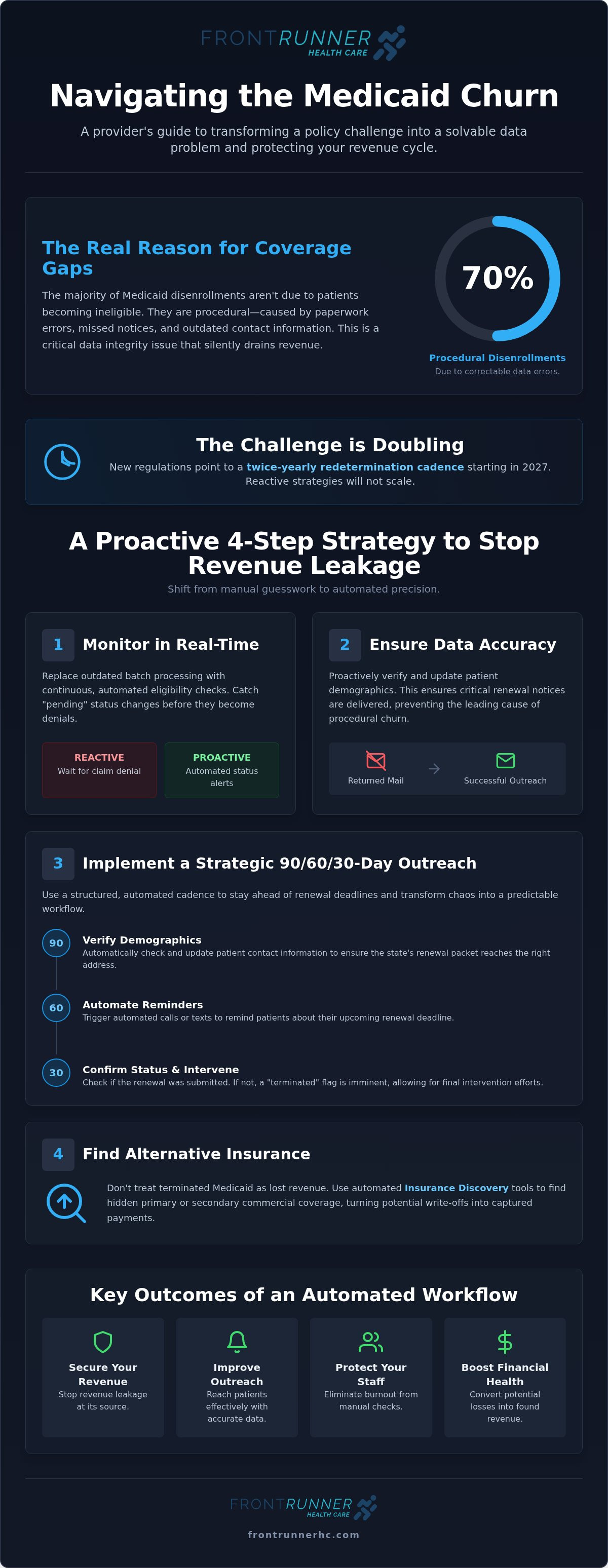
The stakes are getting higher. New regulatory shifts point toward a twice-yearly redetermination cadence starting in 2027. This means the pressure you feel now will soon double. If your RCM team is already struggling to keep up with annual renewals, a semi-annual cycle will be catastrophic without automation. Every gap in coverage represents "found" revenue that is currently slipping through the cracks because of poor visibility. FrontRunnerHC, Inc. understands that you can't afford to wait for a claim to be denied before you realize a patient's status has changed.
Procedural vs. Eligibility Terminations
Most coverage losses aren't what they seem. Industry data suggests that approximately 70% of disenrollments happen because of paperwork errors, not because the patient's income increased. It's a data integrity issue. Missed notices and outdated mailing addresses are the primary culprits. When a renewal packet is sent to a previous residence, the patient never sees it. This "procedural churn" creates silent revenue leakage that manual outreach simply can't catch. It turns active, billable accounts into self-pay burdens overnight, often without the patient even knowing they've lost their benefits.
The 2026 Preparation Window
Now is the time to audit your workflows. Waiting until the 2027 cycle begins to address these inefficiencies is a recipe for financial distress. You need to quantify the cost of disenrollment over the last 12 months to understand the scale of the problem within your own facility. By identifying at-risk populations within your current database, you can begin managing patient coverage gaps after medicaid redetermination more proactively. Tools like PatientRemedi ensure demographic accuracy so your outreach actually reaches the patient, while RedeterminationAssist automates the entire tracking lifecycle. FrontRunnerHC, Inc. provides the boots-on-the-ground support to turn these administrative burdens into streamlined successes.
Monitoring Medicaid Coverage Changes in Real-Time
Batch processing is a relic. It tells you where your revenue was, not where it's going. In 2026, waiting for a claim denial to signal a coverage change is a luxury your bottom line can't afford. High procedural disenrollment rates mean that coverage often vanishes for administrative reasons, even when the patient remains eligible. Managing patient coverage gaps after medicaid redetermination requires a proactive, real-time pulse on every account. You need to catch a "pending" status before it turns into a hard denial. FrontRunnerHC, Inc. enables this shift by replacing manual checks with automated precision.
Efficiency depends on a structured outreach cadence. We recommend a 90/60/30-day cycle. At 90 days out, you should verify demographics to ensure the state's renewal packet reaches the right door. At 60 days, automate a reminder. By the 30-day mark, your team should know if the packet was received or if a "terminated" flag is imminent. This rhythm keeps your staff ahead of the churn. It transforms a chaotic scramble into a predictable, manageable process that preserves your revenue flow.
Automating the Status Check
Manual portal logins are a drain on resources. Your front-desk staff shouldn't spend hours cross-referencing state websites. Instead, use medicaid redetermination assistance software to automate these queries. Setting up logic-based alerts allows your team to focus only on the exceptions. When a patient's status shifts to "pending," an alert can trigger an automated text or call. This proactive approach is the cornerstone of managing patient coverage gaps after medicaid redetermination without exhausting your administrative staff. FrontRunnerHC, Inc. provides the infrastructure to reduce this burden while ensuring no patient falls through the cracks.
Data Integration Strategies
Visibility is your best defense. Your RCM software should speak directly to state Medicaid portals to ensure data freshness. This integration allows for cross-departmental visibility; when the billing office sees a coverage gap, the clinical team can be notified before the patient's next appointment. Maintaining a centralized record of all outreach attempts is also vital. It prevents redundant calls and ensures a cohesive patient experience. FrontRunnerHC, Inc. allows you to optimize your revenue cycle by centralizing these insights into a single source of truth that every department can trust.
How to Reduce Procedural Disenrollment with Data Accuracy
Data integrity is the foundation of any successful revenue cycle strategy. When we discuss managing patient coverage gaps after medicaid redetermination, we are really discussing a communication problem. If the state can't find the patient, the patient can't renew. Returned mail is the single biggest contributor to procedural disenrollment. It's a silent killer of revenue. You can't rely on the patient to update their address at the front desk when they're already stressed about their health. You need a system to scrub and enrich that data before the renewal packet is even printed.
The scale of this challenge is unprecedented. Since the Medicaid continuous enrollment unwinding began, millions have lost coverage simply because they didn't know they needed to take action. This isn't just a policy shift; it's a massive logistical failure. For providers, this means uncompensated care visits are rising not because patients are ineligible, but because the data bridge between the state and the patient is broken. Fixing this bridge requires moving beyond manual entry and adopting automated demographic scrubbing at the point of entry.
Patient Demographic Verification
Validating identity and residency must happen long before the redetermination window closes. Stale data leads to outreach failure. By using healthcare data remediation software, you can verify and update patient information in real-time. This ensures that every SMS, email, or letter actually reaches its target. Multi-channel contact is essential. If a letter is returned, an automated text can bridge the gap. It's about being where the patient is, with the right information, at the right time.
Timing and Outreach Logic
Effective outreach is a matter of precision. Building a "pre-outreach" list for patients entering their 90-day window allows you to be proactive rather than reactive. Don't send generic messages. Personalize your communication based on the specific reason for the churn. Some patients just need a simple reminder, while others need help navigating complex paperwork. Documenting every outreach attempt is equally critical. It protects your organization against claim challenges and provides a clear audit trail. When you have accurate data, managing patient coverage gaps after medicaid redetermination becomes a repeatable, successful workflow instead of a guessing game.
Discovery Strategies: Finding Alternative Insurance Post-Medicaid
"Self-pay" is a dangerous label. It often masks active coverage that simply hasn't been disclosed. When a patient loses Medicaid, they don't always understand their next steps. They might transition to a Marketplace plan or gain coverage through a spouse's employer. Managing patient coverage gaps after medicaid redetermination means assuming that a billable payer exists until you've proven otherwise. You need a systematic way to scan for these alternatives before the account ages out. Don't let found revenue turn into bad debt because of a lack of visibility.
Automated discovery is the only way to handle this at scale. Manual checks are too slow. By the time a staff member calls a patient, the filing window for a commercial plan might have already closed. Automated systems work in the background, identifying primary vs. secondary hierarchies and capturing retroactive coverage. This approach turns "lost" accounts into found revenue. It protects your bottom line while sparing the patient from unnecessary financial stress. It's a strategic shift from being a bill collector to being a coverage detective.
The Insurance Discovery Workflow
A modern workflow doesn't wait for the patient to provide an insurance card. You can scan for active coverage with just a Name and Date of Birth. This capability is vital for managing patient coverage gaps after medicaid redetermination effectively. The system should automatically check for Marketplace plans, COBRA, and even secondary commercial insurance. By establishing the correct hierarchy early, you prevent the "ping-pong" effect of denied claims. This process clears the self-pay backlog and ensures that your RCM team is focused on high-value tasks rather than chasing ghost accounts.
Converting Self-Pay to Reimbursement
Financial disposition is the final step in the discovery process. Once the software uncovers a valid payer, the account status shifts from a liability to a receivable. Many patients are genuinely unaware of their coverage status, especially if they have recently changed jobs or moved. Discovery tools bridge this knowledge gap. They find the data that patients forget. This allows your team to streamline the re-billing process and capture revenue that would otherwise be written off as bad debt. You can uncover hidden revenue by integrating automated insurance discovery into your post-Medicaid strategy.
Integrating RedeterminationAssist into Your RCM
Successfully managing patient coverage gaps after medicaid redetermination requires more than just a search engine; it requires a comprehensive workflow engine. RedeterminationAssist provides this by automating the entire tracking and outreach lifecycle. It doesn't just flag a problem. It initiates a resolution. By combining the demographic precision of PatientRemedi with the automated monitoring of RedeterminationAssist, your organization can move from a reactive posture to a defensive one. This synergy ensures that every outreach attempt is based on the most accurate data available, maximizing the chances of successful renewal or insurance discovery.
FrontRunnerHC, Inc. acts as your strategic partner, shielding your resources from the administrative chaos of the Medicaid churn. Providers utilizing these automated workflows have seen a substantial reduction in uncompensated care, turning what would have been bad debt into captured revenue. As we look toward 2026 and beyond, the frequency of redeterminations will only increase. Your RCM team needs a scalable solution that can handle the volume without adding headcount. We position ourselves as the defender of your time and your bottom line.
Scaling for High-Volume Providers
Diagnostic labs face a unique challenge. They deal with massive volumes and tight turnaround times. They can't wait weeks for a manual eligibility check. RedeterminationAssist accelerates this process, allowing for the rapid discovery of coverage that traditional hospitals might miss. It also streamlines the "clean-up" of old accounts receivable. Instead of letting stale claims expire, the software identifies active payers for historical data, uncovering revenue you may have already written off. This level of automation reduces administrative friction across the entire organization, from the front office to the billing department.
Next Steps for RCM Leaders
Preparation is the best defense against the upcoming 2027 shift to twice-yearly redeterminations. Start by conducting a thorough data integrity audit of your current Medicaid population to identify where your biggest leakage points exist. Once you understand the scale of the problem, request a demo of the automation suite from FrontRunnerHC, Inc. to see how these tools fit into your specific workflow. Building a sustainable strategy now ensures that when the redetermination cadence doubles, your revenue cycle remains stable and your staff remains focused on patient care rather than paperwork. For patient-centric organizations such as Unic Advanced Health Services, this operational efficiency is what allows for consistent primary care and telehealth availability. Managing patient coverage gaps after medicaid redetermination is a long-term commitment to data accuracy and operational efficiency.
The Medicaid landscape is shifting, but your organization's financial stability doesn't have to. You've seen how real-time monitoring and demographic integrity can transform a chaotic renewal cycle into a predictable, automated workflow. By prioritizing data accuracy, you stop procedural disenrollment before it starts. You also turn the "self-pay" myth into tangible reimbursement through automated insurance discovery. Successfully managing patient coverage gaps after medicaid redetermination is about replacing manual guesswork with technical precision.
RedeterminationAssist automates the entire tracking lifecycle, ensuring your team stays ahead of the churn without increasing their administrative workload. Our Insurance Discovery tool identifies hidden primary or secondary coverage to reduce uncompensated care, focusing strictly on revenue recovery rather than direct debt collection. You don't have to navigate these regulatory headwinds alone. With the right tools and a strategic partner in place, you can protect your resources and focus on what truly matters: providing exceptional patient care. Order and precision are within your reach.
Protect your revenue from Medicaid churn—explore RedeterminationAssist today.
Frequently Asked Questions
What is the Medicaid redetermination timeline for 2026?
In 2026, redeterminations occur on a rolling annual basis across the country. Following the initial unwinding period, states have returned to regular renewal cycles where each beneficiary has an individual deadline typically based on their initial application month. This means a portion of your patient population faces a renewal deadline every single month. Continuous monitoring is the only way to stay ahead of these individual state timelines and prevent sudden coverage lapses.
How much does procedural disenrollment cost healthcare providers?
Procedural disenrollment costs the healthcare industry billions in uncompensated care and administrative waste. When a patient loses coverage due to paperwork errors, the provider often carries that visit as a total loss or a self-pay liability. Beyond the direct lost revenue, these gaps increase the cost to collect. Staff spend hours on manual outreach and claim re-submissions, making the process of managing patient coverage gaps after medicaid redetermination a significant drain on resources.
Can insurance discovery software find coverage for a patient with no ID card?
Yes, advanced Insurance Discovery tools can locate active coverage using only a patient's name and date of birth. The software queries a vast network of payers to find primary or secondary insurance that the patient may have forgotten or not yet disclosed. This capability is essential for recovering revenue from "self-pay" accounts where the patient is actually covered by a commercial plan, a Marketplace option, or even a retroactive Medicaid window.
What is the difference between eligibility verification and insurance discovery?
Eligibility verification confirms if a known insurance plan is active for a specific date of service. In contrast, Insurance Discovery proactively searches for unknown or hidden coverage that the patient hasn't provided. While verification is a reactive check, discovery is an active search for "found" revenue. Both are essential components of a robust strategy for managing patient coverage gaps after medicaid redetermination, ensuring that no billable payer is overlooked during the billing cycle.
How does demographic verification improve Medicaid retention rates?
Demographic verification ensures that renewal notices actually reach the patient's current residence. Procedural disenrollment is frequently caused by returned mail or outdated contact information. By using PatientRemedi to scrub and update addresses and phone numbers, you bridge the communication gap between the state and the beneficiary. This accuracy allows patients to receive their renewal packets on time, significantly reducing the likelihood of a coverage lapse due to simple administrative oversight.
Is automated outreach compliant with healthcare communication regulations?
Automated outreach is compliant when implemented with proper safeguards and patient consent frameworks. Tools like RedeterminationAssist are designed to follow TCPA and HIPAA guidelines, ensuring that SMS, email, and voice communications are secure and respectful of patient privacy. This automation allows for a consistent, documented outreach cadence that manual processes can't match. It provides a defensible audit trail of all efforts to assist patients with their coverage renewals while maintaining strict security.
How can hospitals prepare for the 2027 move to twice-yearly redeterminations?
Preparation for the 2027 shift requires immediate investment in automation and data integrity. Hospitals should audit their current Medicaid populations to identify high-risk groups and implement tools like RedeterminationAssist now. Establishing a 90, 60, and 30-day outreach cadence will create a repeatable process that can handle the doubled volume. Moving away from manual portal checks ensures your RCM team isn't overwhelmed when the redetermination frequency increases to twice per year.


Comments