


RCM Automation for Specialty Clinics: The 2026 Data-First Strategy
- FrontRunnerHC

- 1 day ago
- 11 min read
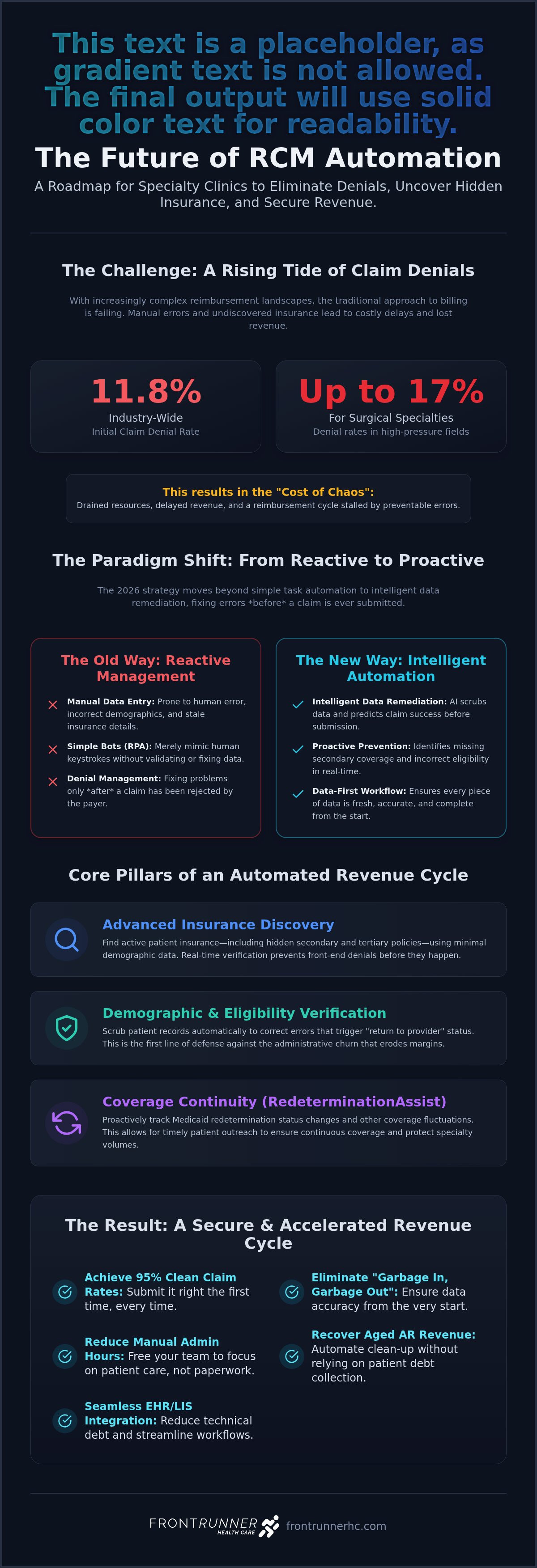
With industry-wide initial claim denial rates climbing to 11.8% in 2026, and some surgical specialties seeing figures as high as 17%, the traditional approach to billing is no longer sustainable. You've likely felt the frustration of watching high-volume workflows grind to a halt because of a single incorrect demographic detail or an undiscovered secondary insurance policy. It's an administrative burden that drains your resources and delays the revenue you've already earned. For many providers, the answer lies in shifting from manual intervention to a sophisticated model of RCM automation for specialty clinics.
This article provides a roadmap for leveraging advanced data automation to eliminate denials, uncover hidden insurance, and secure your revenue in an increasingly complex reimbursement landscape. You'll learn how to transform your front-end processes to achieve 95% clean claim rates and significantly reduce manual administrative hours. We'll examine the mechanics of proactive data scrubbing and the strategic shift toward a data-first workflow that accelerates your entire reimbursement cycle.
Table of Contents
The State of Specialty RCM Automation in 2026
In 2026, the margin for error in specialty billing has effectively vanished. With 76% of RCM leaders now citing automation as their top strategic initiative, the shift from "optional upgrade" to "operational necessity" is complete. However, for labs and diagnostic centers, the standard hospital-grade toolkit often falls short. Revenue cycle management (RCM) in the specialty space requires a surgical focus on data precision that generic platforms simply can't provide. These broad tools often choke on the high-volume, fragmented data streams that define specialty workflows, leading to what we call the "Cost of Chaos." When manual data entry remains the primary method for demographic and insurance verification, initial denial rates can climb as high as 11.8% across the industry, with surgical specialties seeing even higher rates of up to 17%.
Why Specialty Clinics Face Unique Revenue Hurdles
Specialty practices operate in a high-pressure environment where patient data often arrives from disparate external sources. Labs, for example, receive orders from dozens of different referring physicians, each with varying levels of data accuracy. When demographic or insurance details are stale, the reimbursement cycle stalls immediately. Specialty RCM automation is a data-first discipline that prioritizes the accuracy of patient information at the point of intake to ensure downstream financial success. Frequent insurance changes, including the ongoing complexities of Medicaid redeterminations, mean that a patient's coverage today might not be their coverage tomorrow. Without a specialized system to track these shifts, revenue leakage becomes an unavoidable reality.
The 2026 Trend: From Workflow Bots to Data Integrity
The industry has evolved beyond simple Robotic Process Automation (RPA) that merely mimics human keystrokes. In 2026, the focus has shifted from "bots that repeat tasks" to intelligent systems that perform deep data remediation. It's no longer enough to just submit a claim faster; you have to submit it correctly. Modern RCM automation for specialty clinics uses AI to scrub data and predict claim success before the submission ever occurs. This transition from reactive denial management to proactive prevention is the hallmark of a mature 2026 strategy. By identifying missing secondary coverage or incorrect eligibility status in real time, these systems transform the billing department into a proactive revenue protection unit. You aren't just managing a cycle anymore. You're securing the financial foundation of your clinic by ensuring every piece of data is fresh, accurate, and complete.
Core Pillars of Automated Revenue Cycles for Specialty Practices
Specialty clinics can't afford to wait for a claim to bounce before checking coverage. The digital transformation in the revenue cycle has moved beyond simple billing software. It now centers on three core pillars that act as a shield for your bottom line. These pillars ensure that RCM automation for specialty clinics isn't just about speed, but about surgical precision. By automating the most volatile parts of the intake process, you eliminate the friction that leads to revenue leakage. It's a matter of securing the front end to protect the back end.
Advanced Insurance Discovery and Eligibility
Identifying active coverage is the first hurdle. Advanced Insurance Discovery allows your team to find active patient insurance using only a name and date of birth. This is critical for high-volume diagnostic environments where patients often provide outdated or incomplete information. Discovering secondary and tertiary coverage is equally vital for high-cost procedures that might otherwise result in massive patient balances. Real-time verification is the gold standard here. While batch processing works for some, real-time checks prevent front-end denials before the sample is even processed. Demographic Verification complements this by scrubbing patient records for errors that trigger "return to provider" status. It's the first line of defense against the administrative churn that eats into your margins. Implementing these pillars through Advanced Insurance Eligibility Verification ensures your team focuses on patient care rather than chasing paperwork.
Maintaining Coverage Continuity with RedeterminationAssist
Medicaid redetermination continues to be a volatile factor in 2026. As coverage fluctuates, specialty volumes are at risk. RedeterminationAssist helps you manage this ongoing impact by tracking status changes automatically. It allows for proactive patient outreach, ensuring coverage information is updated long before the appointment. You can find more detail on selecting the right tools in our Medicaid Redetermination Assistance Software: The 2026 Provider’s Buying Guide. This level of foresight turns a potential loss into a secured reimbursement. By maintaining coverage continuity, you protect both the patient's access to care and the clinic’s financial health. It’s about being proactive rather than reactive. Automation allows you to see the coverage gaps before they become financial holes, keeping your reimbursement cycle moving without interruption. It's a clean, efficient way to manage patient volume without the manual heavy lifting.
Data Remediation: The Foundation of Specialty RCM Success
Automation is only as effective as the data fueling it. In the high-stakes world of specialty billing, the "Garbage In, Garbage Out" rule isn't just a cliché; it's a primary driver of financial loss. If your automated systems are processing incorrect addresses or expired policy numbers, they aren't saving time. They're simply accelerating the rate at which you receive denials. True RCM automation for specialty clinics requires a foundational layer of data remediation to ensure every record is accurate before it enters the workflow. This proactive approach turns fragmented, partial records into clean, billable claims.
Solving the Fragmented Data Crisis
Data fragmentation is a persistent thorn for specialty clinics. Information often arrives from multiple referral sources, each with its own data entry standards and potential for error. These discrepancies create a ripple effect of administrative friction that slows down your entire reimbursement cycle. Automated scrubbing identifies and corrects these demographic errors instantly, cross-referencing multiple databases to find the most current patient information. For a deeper dive into these technical mechanics, see The Definitive Guide to Healthcare Data Remediation Software in 2026. By cleaning data at the source, you remove the roadblocks that typically lead to "return to provider" status.
PatientRemedi: A Case for Clean Data
PatientRemedi serves as the critical filter for your intake process. It doesn't just flag errors; it fixes them by automating the remediation of stale or incomplete patient records. Clean data is the high-octane fuel that allows RCM automation to run at peak efficiency. When your data is accurate, your automation can perform complex tasks like Financial Disposition. This process uses enriched data to route accounts to the most effective recovery path, whether that's immediate billing or identifying a patient's secondary coverage that was previously hidden. The result is a significant boost to your long-term accounts receivable health. You're no longer just chasing payments. You're building a reliable, data-driven revenue engine that operates with surgical precision and minimal manual intervention.
Strategic Implementation: Integrating Automation into Clinic Workflows
Successful implementation begins with an honest audit of your current technical debt. Many specialty clinics feel trapped by legacy systems that don't communicate effectively. This fragmentation creates friction points where manual data entry becomes the only bridge between the lab and the billing office. By identifying these gaps, you can deploy targeted RCM automation for specialty clinics that solves specific bottlenecks without requiring a total system overhaul. It's about working smarter with the tools you already have, rather than starting from scratch.
LIS and EHR Integration Strategies
Integrating new technology shouldn't mean replacing your EHR or LIS. Strategic RCM automation for specialty clinics sits on top of your existing infrastructure, acting as an intelligent layer that cleans data before it ever hits your billing system. API-driven data flows offer a significant advantage over traditional batch processing. They allow for real-time validation and immediate feedback loops. This ensures data integrity across multiple clinical platforms, preventing the "broken telephone" effect where information is lost or corrupted as it moves through the cycle. By maintaining this connectivity, you ensure that the clinical and administrative sides of the house are always in sync.
Transitioning to Exception-Based Billing
Shifting your team from manual entry to exception-based management is a cultural change as much as a technical one. When you automate the routine tasks, your billing staff can focus on the complex cases that truly require human expertise. This transition significantly reduces staff burnout. It replaces the repetitive drudgery of demographic verification with high-value analysis. You can explore the broader consequences of these manual errors in The Impact of Incorrect Patient Demographics on Billing: A 2026 RCM Guide. Empowering your team to manage exceptions rather than inputs creates a more engaged and efficient workforce.
Measuring the success of your implementation requires a focus on specific KPIs. You should aim for a clean claim rate of 95% or higher. Other critical metrics include a reduction in manual administrative hours and a marked acceleration in your reimbursement cycle. If you're ready to see how these strategies apply to your specific workflow, contact a strategic partner at FrontRunnerHC today. Moving toward an automated, data-first strategy isn't just about software. It's about building a more resilient practice that values both your staff's time and your clinic's financial health.
Maximizing Recovery: AR Clean-Up and Future Trends
The final stage of a data-first strategy isn't just about preventing future losses. It's about reclaiming the revenue currently trapped in your aged receivables. While many clinics resort to aggressive collections or write-offs, a more sophisticated approach exists. RCM automation for specialty clinics allows you to look backward with the same precision used on the front end. By applying automated scrubbing to your existing backlog, you can uncover billable opportunities that were previously dismissed as uncollectible. It's a strategic recovery method that preserves patient relationships while strengthening your balance sheet. You're not just cleaning up old files. You're uncovering lost capital.
Software-Driven Accounts Receivable Recovery
Many aged accounts aren't actually uncollectible. They're simply under-documented. Using Insurance Discovery to clear aged AR backlogs allows you to find active coverage that was missed during the initial intake. This process identifies "billable" versus "uncollectible" accounts early, saving your team thousands in wasted labor hours. Instead of chasing patients for payment, you're uncovering the insurance resources already available to them. This software-driven approach is a cleaner, more efficient alternative to traditional debt collection. For a detailed look at how these tools stack up, review our Retroactive Insurance Discovery: 2026 Comparison Guide. It's about working smarter with the data you already have.
The Future: AI-Powered Denial Prevention
Looking ahead, the role of automation will only deepen. 2026 technology is already moving toward predictive reimbursement modeling. These systems don't just react to denials. They predict payer behavior and denial patterns based on real-time data trends. This foresight allows clinics to adjust their submissions before a problem occurs. Implementing advanced RCM automation for specialty clinics ensures you stay ahead of changing payer rules. Additionally, real-time Financial Disposition will become the standard for routing every account to its optimal path. This level of precision prepares specialty clinics for the shift toward value-based care models, where data accuracy and outcome tracking are paramount. You're building a resilient practice that can handle whatever the reimbursement landscape throws your way next.
The transition to a data-first strategy is a journey. It starts with an honest assessment of your current data health. Auditing your workflows today ensures you aren't leaving money on the table tomorrow. If you're ready to move beyond manual chaos and secure your financial future, it's time to optimize your specialty clinic's revenue cycle today. Precision is the only path to sustainable growth. Don't let your revenue leak through the cracks of a broken system. Secure it with a strategy built for the future.
Securing Your Clinic's Financial Future in a Data-Driven Era
Transitioning to a data-first strategy isn't just about adopting new software. It's about fundamentally changing how your clinic manages patient information. By prioritizing data integrity at the very start of the cycle, you eliminate the administrative friction that leads to high denial rates. RCM automation for specialty clinics provides the precision needed to navigate the complex reimbursement landscape of 2026. It ensures your team spends less time on manual entry and more on high-value tasks that drive clinical success.
Success hinges on having the right strategic partner to help you uncover hidden revenue and maintain coverage continuity. You've seen how tools like Advanced Insurance Discovery and PatientRemedi Data Integrity transform a fragmented workflow into a streamlined, billable engine. With RedeterminationAssist Coverage Tracking, you're always prepared for shifts in payer status before they impact your bottom line. Discover how FrontRunnerHC automates specialty RCM with a data-first approach. Your clinic's growth depends on the accuracy of your data. Take the first step toward a more resilient and profitable revenue cycle today.
Frequently Asked Questions
What is RCM automation for specialty clinics?
It is a strategic approach that uses intelligent software to manage the financial lifecycle of a patient encounter, from intake to final payment. Unlike generic tools, it's built to handle the high-volume, fragmented data common in diagnostic labs and specialty centers. It prioritizes data remediation, ensuring that patient information is accurate and billable before a claim is ever generated. This reduces manual labor and prevents the administrative friction that stalls reimbursement.
How does automated insurance discovery find hidden coverage?
Automated insurance discovery uses advanced algorithms to query vast payer databases using limited patient information, such as a name and date of birth. This process uncovers active primary, secondary, and tertiary coverage that patients may have forgotten to provide or were unaware of. By identifying these billable resources early, clinics avoid sending large, uncollectible balances to patients. It turns potential write-offs into secured revenue by finding the right payer at the point of service.
Can RCM automation integrate with our existing LIS or EHR?
Yes, modern automation solutions are designed to sit on top of your existing Laboratory Information System (LIS) or Electronic Health Record (EHR). You don't need to undergo a costly system replacement to achieve efficiency. Through API-driven integrations or traditional batch processing, these tools create a seamless data flow that corrects errors in real time. This ensures that the information living in your clinical platforms is always synchronized with the most current insurance and demographic data available.
How does patient demographic verification reduce claim denials?
Demographic verification acts as a proactive filter that identifies and corrects errors in patient records before they trigger a denial. Simple mistakes, like a misspelled name or an outdated address, account for a significant portion of rejected claims. By scrubbing this data instantly at intake, the software ensures that every submission meets payer requirements. This accuracy is the first line of defense against the administrative churn that typically delays the reimbursement cycle and drains clinic resources.
What is the difference between RCM automation and traditional medical billing?
Traditional medical billing is often a reactive process that relies heavily on manual data entry and correcting errors after a denial occurs. In contrast, RCM automation for specialty clinics is a proactive, data-first strategy. It uses intelligent scrubbing and real-time verification to prevent errors from entering the system in the first place. While traditional billing focuses on managing the cycle, automation focuses on optimizing the data that fuels that cycle, leading to higher clean claim rates.
Does RCM automation help with Medicaid redetermination?
Automation is essential for managing the ongoing volatility of Medicaid redetermination. Specialized tools like RedeterminationAssist track changes in patient coverage status automatically, allowing your team to identify gaps before an appointment or test occurs. This proactive tracking prevents the sudden loss of reimbursement that happens when a patient's eligibility fluctuates. It ensures coverage continuity by prompting outreach to update information, keeping your patient volume stable and your revenue secured in a shifting regulatory landscape.
How quickly can a specialty clinic see ROI from RCM automation?
Most specialty clinics observe a measurable return on investment within the first few billing cycles after implementation. This ROI manifests through a sharp increase in clean claim rates, often exceeding 95%, and a dramatic reduction in the manual hours required for administrative tasks. By uncovering hidden insurance and preventing denials on the front end, clinics accelerate their reimbursement cycle and capture revenue that would have otherwise been lost to uncollectible patient balances or timely filing limits.
Does FrontRunnerHC provide direct patient debt collection services?
No, FrontRunnerHC does not provide direct patient debt collection services. The focus is entirely on providing the software and data tools necessary to identify billable insurance and clean up patient data. By using solutions like Insurance Discovery and Accounts Receivable Clean-Up, clinics can recover revenue through proper payer channels rather than engaging in aggressive collection tactics. This approach preserves the patient relationship while ensuring the clinic is fairly reimbursed for the specialized services it provides.


Comments