


Automated Patient Data Validation: The 2026 Guide to Demographic Scrubbing
- FrontRunnerHC

- 3 days ago
- 12 min read
Did you know that registration and eligibility errors now account for roughly 24% of all denied claims in 2026? It's a frustrating reality for providers who see their hard-earned revenue stalled by simple address mismatches or "patient not found" errors. You shouldn't have to choose between a bloated administrative headcount and a mounting pile of rejected claims. Manual entry is slow, expensive, and inevitably prone to human error, especially as coverage shifts and Medicaid redeterminations become more frequent. Implementing automated patient data validation isn't just a technical upgrade. It's a strategic necessity to protect your bottom line from the rising 12.6% industry denial rate.
We understand the administrative burden that comes with keeping patient records current. This guide shows you how automated demographic scrubbing eliminates these billing bottlenecks, reduces front-end denials by at least 20%, and secures your revenue cycle. We'll explore the transition from reactive cleanup to proactive, real-time validation. You will discover how to achieve a higher clean claim rate and manage coverage changes with precision. By the end, you'll have a clear roadmap for modernizing your data remediation without adding a single person to your front-office team.
Table of Contents
The Crisis of Static Data: Why Manual Patient Validation Fails
The administrative landscape in 2026 is unforgiving. Healthcare providers find themselves caught between rising operational costs and increasingly stringent payer requirements. At the heart of this struggle is "Administrative Friction," a term that describes the cumulative weight of manual workflows on the revenue cycle. When your front office relies on manual entry, you aren't just dealing with slow processes. You're dealing with a liability. Human error in demographic entry remains the primary reason for preventable denials. A simple typo in a zip code or a misspelled surname can trigger a "patient not found" response, stalling your cash flow instantly.
The Financial Impact of Incorrect Patient Demographics
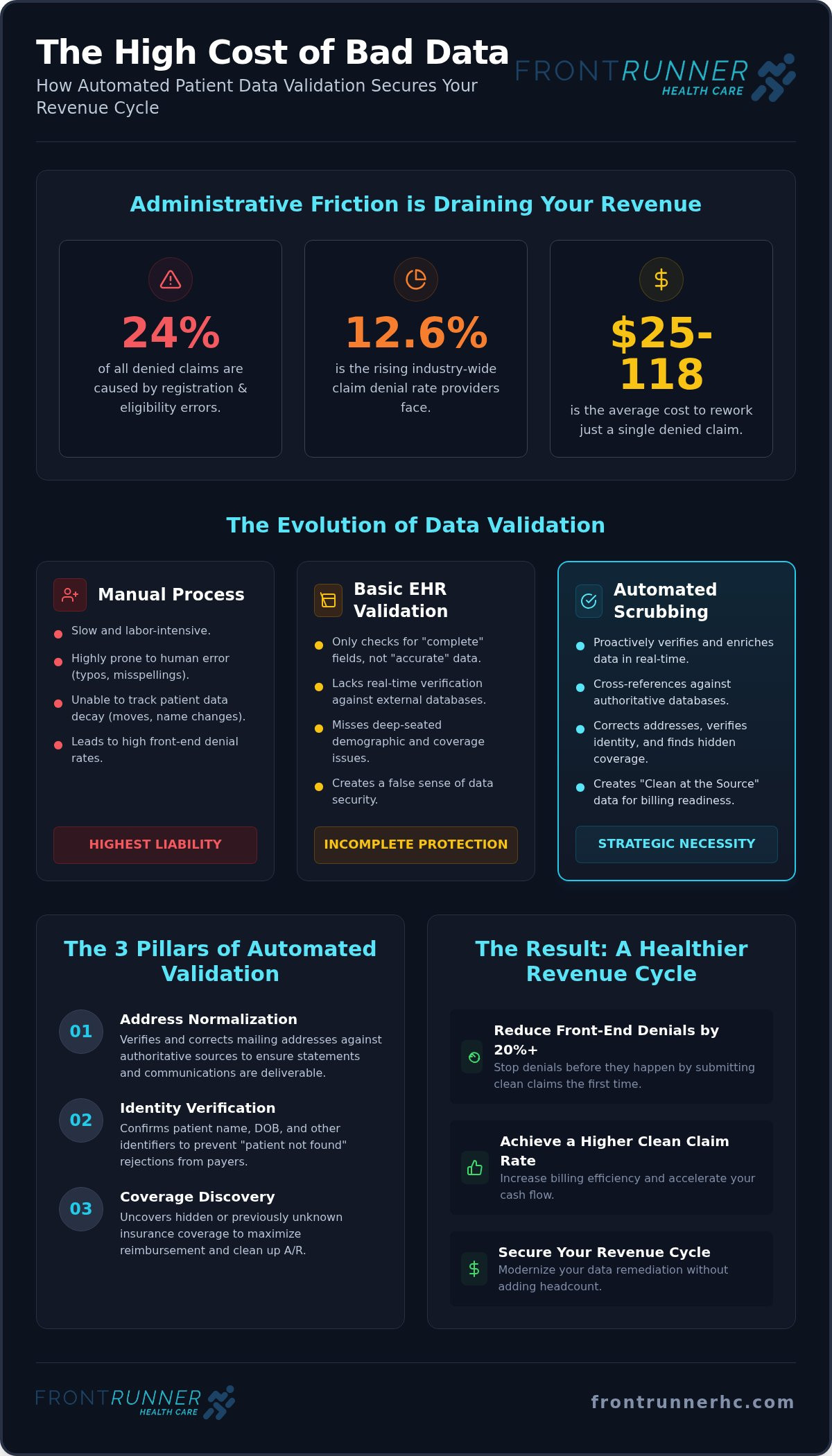
The cost of bad data is staggering. Research indicates that registration and eligibility errors account for roughly 24% of all denied claims in 2026. This isn't just an inconvenience; it's a financial drain. Reworking a single denied claim costs between $25 and $118, a price point that quickly erodes your margins. This breakdown represents more than a clerical error. It's a systemic failure where inaccurate data at the point of registration breaks the entire billing chain:
Inaccurate addresses prevent timely patient statements.
Misspelled names cause "patient not found" rejections from payers.
Outdated phone numbers stall prior authorization and clinical follow-up.
To maintain a healthy revenue cycle, organizations must prioritize Data cleansing or data cleaning to ensure patient records are billing-ready from the start. You can explore a deeper breakdown of these costs in our The Impact of Incorrect Patient Demographics on Billing: A 2026 RCM Guide.
Data doesn't just start wrong; it goes stale. Patient demographics have a surprisingly high "decay rate." People move, change names, and switch insurance plans at a pace that manual systems cannot track. This reality makes automated patient data validation essential. Without it, your records become obsolete faster than your team can update them. When demographics are incorrect, insurance discovery tools fail. Eligibility checks return false negatives. The result is a cycle of rework that adds no value to the patient experience or your bottom line.
Beyond the Entry Point: Why EHRs Aren’t Enough
Many providers assume their Electronic Health Record (EHR) system handles this. It's a common misconception. Most EHRs rely on "Required Field" validation, which only ensures that a box is filled. It doesn't ensure the information inside that box is correct. A field can be "complete" without being "accurate" or "billable." There is a significant gap between registration and claim submission where data integrity often fails because there is no mechanism to verify the information against authoritative sources. Relying on EHR-basic validation is like checking if a door is closed without seeing if it's locked. To achieve true efficiency, you need a layer of automated patient data validation that proactively cleanses data before it enters the billing workflow.
What is Automated Patient Demographic Scrubbing Software?
Think of demographic scrubbing as a digital immune system for your revenue cycle. It's not a passive cleanup tool. It is a proactive, real-time data enrichment process that identifies and fixes errors before they can derail a claim. Demographic scrubbing is the automated cross-referencing of patient identity, address, and insurance info to ensure billing readiness. By moving away from manual "eyeballing" of records, organizations can achieve a level of precision that human staff simply cannot match. This technology doesn't just check for completeness; it verifies accuracy by comparing your internal records against massive, authoritative external databases in milliseconds.
Effective automated patient data validation relies on three pillars: address normalization, identity verification, and coverage discovery. When these elements work in harmony, they transform fragmented patient inputs into clean, billable records. This process is essential for following Best Practices for Data Integrity, especially during system transitions or high-volume registration periods. By validating data at the start, you prevent the "garbage in, garbage out" cycle that plagues many billing departments.
The Technology Behind the Scrub: AI and Real-Time APIs
Modern platforms leverage machine learning to identify complex patterns in data errors that standard EHR filters miss. They use real-time APIs to validate information while the patient is still at the front desk. This immediate feedback loop is critical. It allows staff to correct discrepancies instantly. These systems typically use a mix of deterministic and probabilistic matching. Deterministic matching looks for exact data points, like a Social Security number. Probabilistic matching calculates the likelihood of a match based on multiple variables. Precision matters here. A false match is just as dangerous as a missed one, making the technical sophistication of your scrubbing platform a primary driver of your clean claim rate.
Data Enrichment: Turning Fragments into Complete Records
Scrubbing software does more than just find errors; it "fills in the blanks." If a patient provides an incomplete address or omits a middle name, the software uses credit header data and other public records to complete the profile. This includes USPS-standardized address verification, which is mandatory for claim acceptance. By standardizing every entry, you eliminate the risk of mail returns and "patient not found" denials. If you're looking to optimize your front-end operations, exploring a specialized tool for Demographic Verification can help your team uncover the accurate details needed for seamless reimbursement.
Manual vs. EHR-Basic vs. Specialized Scrubbing Platforms
Evaluating your validation strategy requires looking beyond the "registration complete" message on your screen. Most organizations fall into one of three tiers: manual review, standard EHR validation, or specialized automated remediation. While manual "eyeballing" was once the industry standard, the sheer volume of modern healthcare data makes it impossible to sustain. Relying on human staff to catch every typo or outdated address is a high-risk strategy that often leads to the current 12.6% industry denial rate. For high-volume labs and health systems, the choice isn't just about preference; it's about survival in a landscape where speed and accuracy must coexist.
Standard EHR Validation: The "Better Than Nothing" Tier
EHR systems are primarily built for clinical documentation, not revenue cycle optimization. They excel at basic format checking, such as ensuring a phone number has ten digits or that mandatory fields aren't left blank. However, they lack the external connectivity required for true automated patient data validation. An EHR won't typically tell you if a patient moved across state lines last month or if their Medicaid coverage lapsed during the latest redetermination cycle. They often provide a false sense of security. You might have a "complete" record that is still 100% unbillable because the information inside is stale. To see where your current process might be falling short, review The 2026 Patient Registration Data Quality Checklist for Healthcare Providers.
Advanced Scrubbing: The Strategic Advantage
Specialized platforms transform your data from a static record into a dynamic asset. By integrating automated patient data validation into the front end, you enable advanced Insurance Discovery. This process goes beyond fixing a zip code. It's about uncovering active coverage that the patient might not even know they have. For organizations managing Medicaid populations, this capability is vital. Tools like RedeterminationAssist allow for continuous monitoring of coverage changes, preventing the sudden "coverage terminated" denials that spike during redetermination periods.
The ROI of moving to a specialized platform is clear. You're balancing a software license against the high cost of manual rework and lost revenue. Specialized scrubbing doesn't just work faster; it works smarter by shifting your billing staff from the tedious role of "Data Entry" to the high-value role of "Data Oversight." This transition allows you to reduce front-end denials by at least 20% without increasing your headcount. You aren't just cleaning data. You're securing your revenue cycle against the friction of an increasingly complex administrative environment.
Best Practices for Implementing Automated Data Validation
Implementing automated patient data validation requires more than just a software installation. It's a strategic shift in how your organization handles identity and coverage. To see a real return, you must move beyond reactive cleanup. Follow these five steps to build a resilient, data-first revenue cycle. Success starts with a clear understanding of your current friction points.
First, audit your current denial reasons to identify demographic hotspots. Look for patterns in "patient not found" or "invalid subscriber" codes. This data tells you exactly where your front-end process is leaking revenue. Second, establish a "Clean at the Source" protocol. Your front-desk staff are the gatekeepers. When they have real-time validation tools, they can fix errors before the patient leaves the lobby. Third, ensure your scrubbing software integrates directly into your existing EHR and LIS workflows. Frictionless data flow is the only way to maintain speed.
Don't ignore your existing backlog. Step four involves automating retroactive scrubbing for aging accounts receivable. Because patient data decays at a high rate, cleaning your older claims can uncover active insurance coverage that was previously hidden, allowing you to recover revenue without increasing headcount. Finally, monitor your performance through clean claim rates and denial reduction metrics. If you aren't measuring the impact, you can't optimize the process.
Setting the Standard for Patient Address Verification
Address errors are a silent killer of cash flow. Implementing real-time normalization prevents the "Return to Sender" loop that delays patient billing and outreach. A standardized address is the foundation of identity management. Without it, you cannot reliably match patients to their insurance records. You can find detailed steps on this in our 2026 Guide: Patient Address Verification Best Practices. Ensuring every record meets USPS standards is a simple change that yields immediate results in claim acceptance and patient communication.
Training Staff for a Data-First Culture
Technology is only half the battle. Your team must move from a mindset of manual data entry to one of "Exception Handling." Instead of typing every character, staff should use software insights to verify and correct discrepancies. This shift reduces burnout and improves accuracy. Use the reporting features in your validation platform to coach staff on common registration errors. When you provide clear feedback and incentives for high clean-claim rates, you foster a culture that values precision over speed. If you are ready to modernize your workflow, explore how our Demographic Verification solutions can empower your team.
FrontRunnerHC: Achieving Data Integrity with PatientRemedi
Healthcare administrative work is often a battle against stale data and shifting payer rules. It's a complex environment where precision is the only way to maintain financial stability. FrontRunnerHC serves as a strategic partner to navigate this complexity. Our flagship solution, PatientRemedi, provides the automated patient data validation needed to secure your revenue cycle. It isn't just about finding errors. It's about uncovering opportunities. By automating the identification of active insurance coverage, PatientRemedi ensures that every patient interaction is backed by accurate, billable data.
One of the most powerful features of our platform is Financial Disposition. This capability allows your team to prioritize accounts based on the likelihood of reimbursement. It moves your workflow from guesswork to strategic action. Instead of chasing every lead, your staff focuses on the most viable claims. This efficiency extends to our Accounts Receivable Clean-Up service. We help you recover revenue from aging accounts by identifying previously missed coverage. Crucially, we achieve this without resorting to direct patient debt collection. It's a cleaner, more empathetic approach to revenue recovery that preserves the patient relationship while protecting your margins.
Why Leading Providers Choose FrontRunnerHC
Leading health systems and high-volume labs view us as an authoritative expert in data remediation. We don't just offer software; we offer a way out of administrative friction. PatientRemedi integrates seamlessly with your existing billing systems, whether you're using a standard EHR or a specialized LIS. This interoperability is essential for reducing uncompensated care. By ensuring data integrity at the start, our partners see a measurable decrease in the "patient not found" denials that often stall cash flow. We provide the technical sophistication required to handle the most complex demographic challenges with a practical, boots-on-the-ground approach.
The 2026 Roadmap to a Denial-Free Revenue Cycle
The landscape of 2026 requires a proactive stance. Payer requirements will continue to evolve, but a clean, enriched patient database remains your best defense. Implementing automated patient data validation prepares your organization for future shifts by creating a foundation of reliable information. You aren't just fixing today's claims. You're building long-term institutional value. A denial-free revenue cycle is possible when you eliminate the guesswork and replace it with precision. Ready to see the difference for yourself? Schedule a demo of PatientRemedi today and take the first step toward total data integrity.
Securing Your Revenue Future with Precision Data
The administrative landscape of 2026 doesn't leave room for guesswork. Static patient records are no longer just a nuisance; they're a direct threat to your bottom line. By moving away from manual entry and basic EHR filters, you eliminate the friction that leads to costly denials. Implementing automated patient data validation transforms your data from a liability into a strategic asset, ensuring that every claim is billing-ready before it leaves your office.
FrontRunnerHC is trusted by national healthcare organizations to navigate these complexities. Our platform offers advanced insurance discovery capabilities and specialized Medicaid redetermination assistance to keep your revenue cycle moving. You don't have to accept high denial rates as a cost of doing business. It's time to uncover hidden coverage and accelerate your recovery processes with a partner who understands the ground-level challenges of modern healthcare. Optimize your revenue cycle with PatientRemedi and take control of your financial health today. A cleaner, more efficient future is well within your reach.
Frequently Asked Questions
What is the difference between data validation and data scrubbing?
Data validation typically refers to a basic check to ensure information is in the correct format or that mandatory fields aren't empty. Data scrubbing is a more intensive, proactive process of remediation. It involves cross-referencing your internal records against massive external databases to correct typos, update addresses, and enrich the record with missing details. Scrubbing ensures the data isn't just present, but accurate and billable.
How does automated demographic scrubbing reduce claim denials?
It eliminates the root causes of "patient not found" or "invalid subscriber" rejections before they occur. Since registration and eligibility errors cause roughly 24% of all denied claims, fixing these issues at the source is vital. By using automated patient data validation, you ensure that names, addresses, and dates of birth match the payer's records exactly, which significantly improves your clean claim rate.
Can patient demographic scrubbing software integrate with my current EHR?
Yes, specialized platforms like PatientRemedi are designed to integrate directly with existing EHR and LIS workflows. This connectivity allows for a seamless exchange of data without forcing your staff to switch between different applications. Real-time integration ensures that when an error is identified, it's flagged and corrected within your primary billing system, maintaining a single source of truth for all patient information.
How often should patient data be validated or scrubbed?
Ideally, validation should happen at every point of contact. Patient data decays rapidly as people move, change names, or switch insurance plans. You should implement real-time validation during registration to catch errors immediately. Additionally, monthly retroactive scrubbing for your aging accounts receivable is a best practice. This helps you stay ahead of coverage shifts and ensures your historical records remain accurate for future billing needs.
Does automated validation help with Medicaid redetermination?
It's a critical tool for managing these transitions. Specialized solutions like RedeterminationAssist monitor coverage status changes in real-time. As Medicaid redeterminations occur, the software identifies patients who have lost coverage or moved to a different plan. This allows your team to update records and verify new eligibility before a claim is submitted, preventing the sudden spikes in denials that often follow redetermination cycles.
What are the most common patient demographic errors in medical billing?
The most frequent errors include misspelled names, transposed dates of birth, and outdated addresses that don't meet USPS standards. These simple mistakes are the primary drivers of the 12.6% industry denial rate. Other common issues involve incorrect insurance group numbers or missing middle initials. Automated tools catch these discrepancies by comparing your entries against authoritative databases, ensuring every data point is verified and standardized for payer acceptance.
Is automated patient data validation HIPAA compliant?
Yes, professional validation platforms are built with high-level security protocols to protect patient privacy. These systems use encryption and secure APIs to exchange information, ensuring that all automated patient data validation processes meet federal HIPAA requirements. By automating the process, you also reduce the number of staff members who need to manually handle sensitive PHI, which can actually lower your organization's overall risk of a data breach.
How much revenue can a hospital recover through demographic scrubbing?
While results depend on your current denial volume, many organizations reduce front-end denials by at least 20%. By uncovering active insurance that was previously unknown, you can recover revenue from claims that might otherwise be written off as uncompensated care. This process allows you to clean up your accounts receivable and capture reimbursement for services already rendered, all without the need for aggressive patient debt collection tactics.


Comments