


Preventing Duplicate Medical Records: 2026 Billing Guide
- FrontRunnerHC

- 2 days ago
- 12 min read
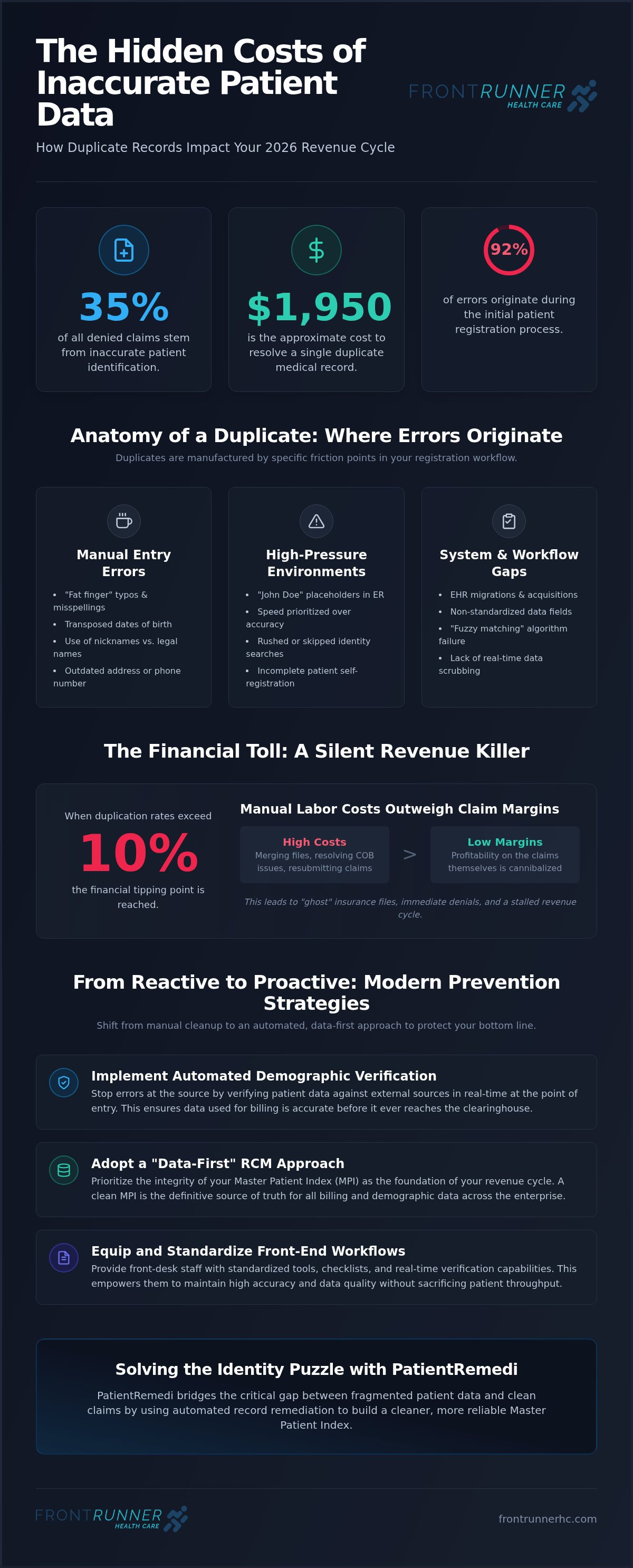
Did you know that 35% of all denied claims in 2026 stem directly from inaccurate patient identification? Every single duplicate record costs your organization approximately $1,950 to resolve, yet 92% of these errors originate during the initial registration process. You're likely all too familiar with the administrative exhaustion that follows: manual labor spent merging split files and the frustration of inaccurate insurance discovery. It's a heavy burden for any front-end team to carry while trying to maintain a steady revenue cycle.
The good news is that you don't have to settle for a fragmented system. This guide reveals how to protect your bottom line by preventing duplicate medical records and securing patient data integrity from the start. We'll show you how to move beyond manual cleanup toward a more precise, automated approach. You'll discover how to achieve a cleaner master patient index, leverage real-time demographic verification, and ultimately lower your denial rates to keep your organization's financial health as robust as the care you provide.
Table of Contents
The 2026 State of Patient Identity Management for Billing
Patient identity management for billing is the critical foundation of any successful revenue cycle. It's the process of ensuring every clinical encounter attaches to the correct financial profile. In the 2026 healthcare landscape, rapid hospital mergers and the explosion of telehealth services have made this task significantly more complex. Every new acquisition or virtual touchpoint introduces a fresh opportunity for data fragmentation. The Master Patient Index (MPI) serves as the definitive source of truth for all billing and demographic data across the enterprise. Adopting a "data-first" approach to revenue cycle management means prioritizing record integrity at the point of entry rather than attempting to fix broken claims weeks later.
Why Patient Accuracy is the First Line of RCM
Accuracy drives revenue. There's a direct, unbreakable link between accurate identity and clean claim rates. When patient data is fragmented, it often leads to "ghost" insurance files. These are instances where a patient has active coverage, but the billing team can't find it because the record is split or misspelled. This disconnect triggers immediate denials. Effective strategies for preventing duplicate medical records start at the front desk. Progressive providers are moving away from manual registration, which is prone to human error, and shifting toward automated demographic verification. This ensures that the data used for billing is verified against external sources in real time, stopping errors before they reach the clearinghouse.
The 2026 Industry Benchmark for Duplication Rates
Most large hospital systems currently struggle with a duplication rate between 10% and 20%. These rates persist because of interoperability gaps between disparate systems. Even within a single Electronic health record (EHR), data decay happens quickly if preventing duplicate medical records isn't a core operational priority. Data decay kills margins. There's a specific tipping point where this decay begins to cannibalize profitability. When duplicate rates exceed 10%, the manual labor required to merge files and resolve Coordination of Benefits issues often outweighs the margin on the claims themselves. Clean data isn't just a goal; it's a financial necessity.
Anatomy of a Duplicate: Why Identity Errors Occur
Duplicate records don't just happen; they're manufactured by specific friction points in your registration workflow. These errors frequently stem from the "fat finger" problem, where simple manual entry mistakes create immediate data silos. Transposed birthdates, misspelled surnames, or the use of nicknames instead of legal names lead to the creation of split files. If a patient is registered as "Elizabeth" during one encounter and "Beth" the next, most systems will fail to link the two identities. These discrepancies might seem minor at the front desk, but they're the primary drivers of data decay in your master patient index.
Emergency settings introduce a unique set of challenges that compromise data integrity. In high-pressure trauma or ER environments, "John Doe" placeholder records are often used to initiate life-saving care without delay. If these temporary files aren't reconciled with the patient's existing history before the billing cycle begins, they become permanent "zombie" duplicates. These split files eventually trigger coordination of benefits denials because your insurance discovery process cannot link the two accounts. Even patient self-registration portals, designed to improve efficiency, inadvertently fuel the crisis. Patients often enter information that differs slightly from their official insurance record, bypassing standard matching logic and creating new, unverified identities.
Registration Workflow Bottlenecks
Front-desk staff face immense pressure to move patients through the queue as quickly as possible. This prioritization of speed over accuracy often means that thorough identity searches are skipped or rushed. Without real-time demographic scrubbing at the point of entry, errors become baked into the revenue cycle. It's helpful to equip your team with standardized tools to manage these high-pressure moments. Reviewing the 2026 patient registration data quality checklist can help your staff maintain precision without sacrificing throughput.
Technical Interoperability Gaps
During EHR migrations or hospital acquisitions, data mismatches are rampant. Non-standardized data fields across different platforms make it difficult for systems to communicate effectively. "Fuzzy matching" algorithms, while sophisticated, often fail when the baseline data is already stale or incomplete. Inconsistent address formats, like "123 Main St" versus "123 Main Street, Apt 4," frequently confuse these systems and lead to split records. This technical gap makes preventing duplicate medical records an uphill battle for organizations relying solely on native EHR functionality. Utilizing Demographic Verification tools from FrontRunnerHC, Inc. provides the real-time accuracy needed to stop these errors before they reach your billing department.
The Financial Toll: Why Duplicates are a Silent Revenue Killer
Every duplicate record in your system carries a heavy price tag. Industry data from 2026 confirms that resolving a single duplicate medical record costs approximately $1,950 in administrative labor and resources. It isn't just a minor clerical annoyance; it's a direct hit to your bottom line. Your team likely spends hundreds of hours every month manually merging records, time that should be spent on high-value revenue cycle tasks. This manual effort is a reactive band-aid for a systemic problem that originates at the front end. When data is fragmented, you lose visibility into the patient's complete history, creating a "hidden insurance" problem where active coverage remains buried in a duplicate file while your team struggles to collect payment.
The financial impact extends far beyond labor. Coordination of Benefits (COB) denials are frequently triggered by these split files. When a payer receives a claim but sees conflicting demographic or insurance data in their own system, they'll stop the payment process immediately to determine the primary payer. This causes your cash flow to stall. You can read more about the impact of incorrect patient demographics on billing to understand how these small errors ripple through the entire RCM chain. Preventing duplicate medical records is the only way to secure your revenue cycle against these avoidable delays.
Denial Management and Revenue Leakage
Patient misidentification is a leading cause of "Patient Not Found" rejections, which account for a significant portion of front-end denials. The cost of rework is staggering. It typically costs $25 or more in administrative expenses to fix and resubmit a single denied claim. When you multiply that by the thousands of claims processed each month, the leakage becomes unsustainable. These errors bloat your accounts receivable (A/R) days and force your staff into a cycle of constant cleanup rather than proactive management.
Uncompensated Care and Financial Disposition
One of the most dangerous consequences of data fragmentation is the misclassification of patients. Without a clear, unified record, you might classify a patient as "Self-Pay" when they actually have active insurance coverage hidden in a duplicate file. This obscures the patient's true financial responsibility and leads to unnecessary uncompensated care. Using Financial Disposition tools allows you to prioritize your accounts receivable cleanup by identifying which patients truly lack coverage and which simply have split records. By uncovering this "lost" insurance, you can convert potential bad debt into realized revenue.
Modern Strategies for Preventing Duplicate Medical Records
Effective strategies for preventing duplicate medical records require a shift from reactive cleanup to proactive prevention. In 2026, relying on front-desk staff to catch every nuance is no longer a viable financial strategy. You need a multi-layered defense that starts with real-time demographic verification at the very first point of contact. By validating identity before a new file is even created, you stop the creation of split records before they can contaminate your database. Standardizing entry protocols, such as following USPS address standards, further eliminates the technical mismatches that often confuse matching algorithms. Establish a regular "Data Hygiene" schedule for MPI maintenance to ensure that your records remain accurate as patient life events occur.
Automated Demographic Scrubbing
Automation is your strongest ally in the fight against data decay. Automated systems can instantly identify mismatches in dates of birth, Social Security numbers, and physical addresses that a human eye might easily overlook during a busy shift. This technology doesn't just find errors; it provides "suggested match" prompts to registrars, significantly reducing their cognitive load and the pressure to "just create a new file." For a deeper dive into these workflows, explore the guide on demographic scrubbing to see how these tools integrate into your existing revenue cycle. When you automate the validation process, you move from guessing to knowing, ensuring that every claim is built on a foundation of verified data.
Address and Identity Verification Best Practices
Maintaining an accurate Master Patient Index (MPI) requires constant vigilance against shifting patient data. Utilizing National Change of Address (NCOA) data is a baseline requirement for modern billing. By cross-referencing your internal records with external, authoritative data sources, you achieve a level of certainty that manual entry cannot match. This process uncovers the accurate, current information needed to link disparate records that might otherwise remain split. Check out our patient address verification best practices to refine your front-end protocols and eliminate the "fat finger" errors discussed earlier. Verifying identity against these external sources ensures 100% certainty before a claim is ever generated.
These strategies work together to create a resilient revenue cycle that isn't paralyzed by clerical errors. When you implement these modern standards, you're not just cleaning up data; you're securing your organization's financial future. To see how these tools can transform your specific workflow, consider implementing Advanced Insurance Eligibility Verification to ensure every patient record is backed by real-time, verified coverage data.
Solving the Identity Puzzle with PatientRemedi
PatientRemedi acts as the definitive solution for healthcare data remediation. It isn't just another software layer; it's a strategic partner that resolves the underlying data issues that trigger financial friction. While many tools focus solely on clinical safety, PatientRemedi addresses the financial heart of the matter by automating the identification of split patient files that traditional systems often miss. By scrubbing your existing database and uncovering the links between fragmented records, it effectively succeeds in preventing duplicate medical records from continuing to drain your resources. It transforms your master patient index into a high-performance asset rather than a lingering administrative liability.
Integrating insurance discovery with identity management is the most effective way to maximize revenue recovery. When your data is clean, your ability to find hidden coverage increases exponentially. We've seen how automated workflows significantly reduce uncompensated care by uncovering active insurance policies buried within duplicate profiles. This remediation process ensures that every clinical encounter is backed by the most accurate financial data available, allowing your team to move away from the chaos of manual merging and toward a more precise, outcome-focused operation.
A Unified View of the Patient
Data fragmentation creates a fog that obscures your true financial position and complicates every step of the billing process. PatientRemedi clears this fog by consolidating fragmented demographics into a single, billable record. It serves as the essential bridge between front-end registration and back-end billing, ensuring that the information captured at the start of the patient journey remains consistent throughout the entire revenue cycle. FrontRunnerHC, Inc. discovers hidden insurance coverage by cleaning the data first, which eliminates the "hidden insurance" problem where coverage exists but remains inaccessible due to a misspelled name or an old address. This unified view simplifies coordination of benefits and ensures that no billable event is lost to a clerical error.
Next Steps: Optimizing Your Revenue Cycle
Moving from a reactive stance to a proactive prevention model is the most significant step an organization can take toward long-term financial stability. It's time to stop the cycle of manual labor and constant rework. You can start this transition by requesting a comprehensive data health check to identify exactly where your MPI is leaking revenue. This diagnostic look at your data reveals the "zombie" records and split files that are currently triggering your highest denial rates. Don't let stale data dictate your profitability or slow down your cash flow. Take the first step toward a cleaner, more efficient system today and Optimize your patient data with FrontRunnerHC, Inc..
Securing Your Financial Future Through Data Integrity
Transitioning to a high-performance revenue cycle requires more than just clinical excellence; it demands absolute data integrity. By prioritizing preventing duplicate medical records, you eliminate the systemic friction that leads to coordination of benefits delays and unnecessary uncompensated care. This strategic shift ensures your administrative staff can focus on high-value tasks rather than the constant manual labor of merging split files or correcting registration typos. It's about moving from a reactive cleanup mindset to a proactive, data-first strategy that protects your bottom line.
FrontRunnerHC, Inc. offers the precision and automation necessary to navigate the fragmented healthcare landscape of 2026. Through PatientRemedi and our comprehensive suite of insurance discovery tools, we empower your organization to uncover hidden revenue and maintain a pristine master patient index across all touchpoints. Discover how PatientRemedi can clean your data and accelerate your revenue cycle. Take control of your financial health today by turning data accuracy into a competitive advantage and a foundation for sustainable growth.
Frequently Asked Questions
What is the primary cause of duplicate medical records in healthcare?
The primary cause of duplicate records is human error during the registration process. Research indicates that 92% of identification errors happen during initial data entry. This occurs when staff are pressured to move quickly, leading to typos or the creation of new files instead of searching for existing ones. Inconsistent naming conventions, such as using nicknames or omitting middle initials, further complicate the database. These small mistakes eventually compromise the integrity of the entire revenue cycle.
How do duplicate patient records affect medical billing and RCM?
Duplicate records act as a massive barrier to timely reimbursement. They frequently trigger Coordination of Benefits (COB) denials because the payer sees conflicting information across split files. Industry data shows that 35% of denied claims result from inaccurate identification. When a patient's history is divided, your team might misclassify them as self-pay, even if active coverage exists elsewhere. This fragmentation bloats your accounts receivable (A/R) days and increases manual labor for clean-up.
Can automated software prevent duplicate records at registration?
Yes, automated software is the most effective defense for preventing duplicate medical records. Tools like Demographic Verification use real-time data scrubbing to validate identity at the point of entry. By cross-referencing external, authoritative sources, these systems identify mismatches in birthdates or Social Security numbers before a duplicate can be created. This proactive approach reduces the cognitive burden on your registration staff and ensures that every new record is unique and accurate.
What is a Master Patient Index (MPI) and why does it matter for billing?
A Master Patient Index (MPI) is a centralized database that serves as the definitive source of truth for patient identification across an organization. For billing, a clean MPI is essential because it ensures that every clinical encounter is linked to the correct financial profile. Without a well-maintained MPI, your revenue cycle becomes fragmented. Maintaining this index is critical for ensuring that insurance discovery tools can successfully locate active coverage for the right individual.
How much does it cost a hospital to merge a duplicate record manually?
Manual record resolution is a significant financial drain. Industry benchmarks for 2026 show that it costs a healthcare organization approximately $1,950 to resolve a single duplicate record. This figure includes the labor hours spent by HIM and billing staff to investigate, verify, and merge files. It also accounts for the lost revenue from denied claims and the administrative costs of reworking split files. Automation provides a much higher return on investment by stopping these costs at the source.
How does insurance discovery work with duplicate patient files?
Insurance discovery relies on clean demographic data to find hidden coverage. When a patient has duplicate files, their active insurance policy might be attached to an old address or a misspelled name in a "ghost" record. Advanced tools from FrontRunnerHC solve this by first remediating the patient's identity. Once the records are unified, the software can more accurately search national databases to uncover coverage that would otherwise remain lost in a fragmented system.
Is patient identity management for billing different from clinical identity management?
While both disciplines share a goal of accuracy, identity management for billing specifically focuses on financial liability and coverage discovery. Clinical management prioritizes patient safety and treatment history. Billing-focused identity management ensures that demographic data matches the requirements of insurance payers to prevent "Patient Not Found" rejections. It's about securing the revenue cycle by ensuring that every claim is backed by verified eligibility and accurate financial disposition data.
What are the best practices for maintaining data hygiene in a 2026 healthcare system?
Modern data hygiene requires a shift toward automation and real-time validation. Best practices include implementing USPS address standards and utilizing National Change of Address (NCOA) data to keep records current. Organizations should also use automated remediation tools like PatientRemedi to scrub existing databases for split files. By establishing a regular schedule for MPI maintenance and using real-time verification at registration, you can maintain a high standard of data integrity across your entire enterprise.


Comments