


Front-End vs. Back-End RCM: 2026 Guide for Providers
- FrontRunnerHC

- 12 minutes ago
- 12 min read
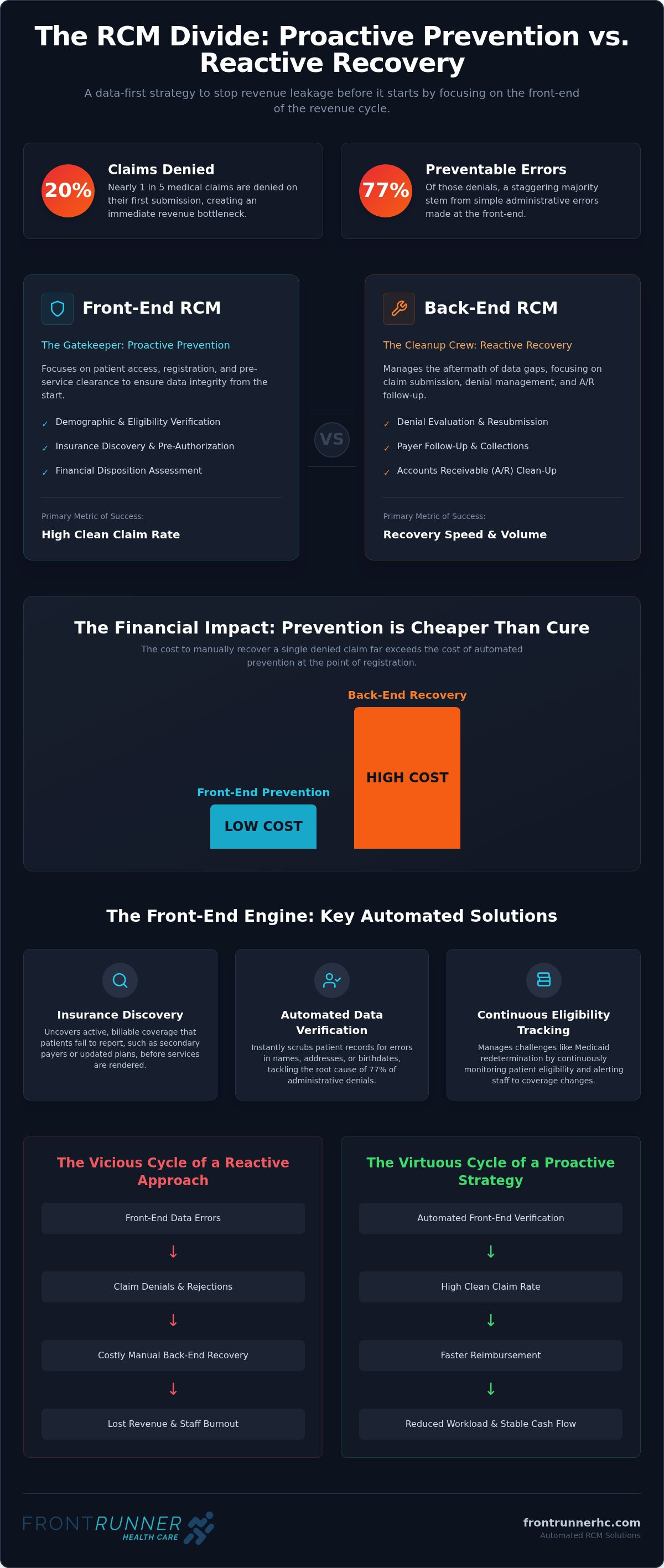
Nearly 20% of medical claims are denied on their first submission in 2026, yet 77% of those rejections stem from preventable administrative errors. You're likely exhausted from chasing revenue that should have been yours months ago, especially when deciding between front-end vs back-end RCM software. The high cost of manual labor for coverage discovery and the ongoing surge of Medicaid redeterminations have forced many billing departments into a reactive, defensive posture. It feels like you're constantly trying to plug holes in a sinking ship.
This guide explores how a data-first strategy can stop revenue leakage before it starts. We'll examine how automating the front end with tools like PatientRemedi and RedeterminationAssist creates a cleaner, faster path to reimbursement. You'll learn how to lower denial rates, reduce manual workloads, and gain comprehensive visibility into patient coverage. By the end, you'll see how shifting your focus from back-end recovery to front-end precision can stabilize your bottom line and reclaim your staff's valuable time.
Table of Contents
Defining the Split: Front-End vs. Back-End RCM Software in 2026
The Front-End Engine: Automation for Insurance Discovery and Eligibility
Comparison: Front-End Prevention vs. Back-End Recovery Software
The Mid-Cycle Bridge: Why Data Remediation is the Missing Link
Optimizing Your Revenue Cycle with FrontRunnerHC’s Automated Solutions
Defining the Split: Front-End vs. Back-End RCM Software in 2026
Revenue cycle management (RCM) is often viewed as a single, continuous stream, but a sharp divide exists between the two halves of the process. Understanding the distinction between front-end vs back-end RCM software is vital for any provider looking to protect their margins in 2026. The front-end focuses on patient access, registration, and pre-service financial clearance. It is the gatekeeper of the entire cycle. In contrast, the back-end handles claim submission, denial management, and accounts receivable (A/R). While both are necessary, they require entirely different technical approaches and staff skill sets.
A provider's clean claim rate serves as the ultimate barometer for front-end success. This metric tracks how many claims reach the payer without requiring a manual correction. High clean claim rates indicate a healthy, automated intake process. Conversely, the back-end is often measured by recovery speed and total collection volume. The financial contrast is stark. Preventing a denial at the front end is several times cheaper than the high expense of manual back-end recovery. Chasing a single denied claim can cost a practice significantly more in labor than the initial registration ever did. Efficient Revenue cycle management (RCM) hinges on this balance of prevention over cure.
The Front-End: Where Data Integrity Begins
Data integrity starts the moment a patient schedules an appointment. Front-end automation prioritizes Demographic Verification and real-time eligibility to ensure the information entering the system is fresh and accurate. By implementing automated Financial Disposition at the point of entry, your team can determine a patient's ability to pay before they ever see a provider. Pre-authorization tools also play a critical role. They eliminate "preventable denials" by confirming that the payer will cover the specific procedure. This proactive stance turns registration from a clerical task into a strategic financial safeguard.
The Back-End: Managing the Aftermath of Data Gaps
When the front-end fails, the back-end pays the price. This phase is characterized by the labor-intensive process of denial evaluation and resubmission. Back-end software often focuses on Accounts Receivable Clean-Up and persistent payer follow-up. While these tools are essential for capturing revenue that has already slipped through the cracks, they cannot fix the root cause of the problem. Relying solely on back-end tools to address systemic data errors is like trying to dry a floor while the faucet is still running. It is reactive, exhausting, and ultimately limits the total revenue your organization can collect.
The Front-End Engine: Automation for Insurance Discovery and Eligibility
The front end is the most vulnerable point in your revenue cycle. When choosing between front-end vs back-end RCM software, providers must recognize that the front end is where data is either captured correctly or lost forever. Insurance Discovery software serves as a powerful safety net in this phase. It uncovers active, billable coverage that patients often fail to report, such as secondary payers or updated commercial plans. By identifying these sources before the clinical encounter, you eliminate the need for costly back-end "hunting" sessions. Catching these gaps early ensures that the clinician's time is spent on care rather than administrative rework. This proactive approach turns a potential write-off into a clean claim from day one.
The landscape of 2026 demands a higher standard of precision. With automated patient data verification, organizations can move away from the "hope and pray" method of registration. This technology cross-references patient information against thousands of data points in real time. It is especially critical for managing the Medicaid unwinding challenge. Tools like RedeterminationAssist track patient eligibility status continuously, alerting your team to coverage changes before they disrupt your cash flow. This level of foresight is no longer a luxury; it is a survival requirement in a market where Medicaid Managed Care denial rates can climb near 25%.
Automated Demographic Verification
Inaccurate patient records are the primary driver of revenue leakage. Simple errors in names, addresses, or birthdates account for a massive portion of the 77% of denials attributed to administrative mistakes. Software like PatientRemedi scrubs this data instantly, ensuring that every record is claim-ready before it leaves the registration desk. Maintaining high patient registration data quality is the most direct way to boost your first-pass payment rates. Clean data at the start means fewer hours spent on manual corrections at the end.
Real-Time Eligibility and Medicaid Tracking
Modern RCM requires more than a simple "active" or "inactive" response from a payer. You need deep benefit verification that details co-pays, deductibles, and specific service limitations. As Medicaid redeterminations continue to cause massive self-pay volume, tracking these shifts in real time allows your staff to pivot to alternative coverage or financial assistance immediately. Real-time monitoring prevents coverage gaps from turning into uncollectible write-offs by flagging eligibility changes at the moment they occur. If you want to see how these automated engines can stabilize your revenue, consider exploring FrontRunnerHC's data integrity solutions to secure your front-end processes.
Comparison: Front-End Prevention vs. Back-End Recovery Software
Choosing between front-end vs back-end RCM software isn't merely a technical decision; it's a strategic choice between prevention and recovery. The cost per claim tells the most compelling story. Front-end automation handles tasks like eligibility and demographic verification for a fraction of the cost of manual back-end intervention. When a claim is denied, the labor required to investigate, appeal, and resubmit it skyrockets. This reactive approach also drags down your "Time to Pay." Front-end tools accelerate the revenue cycle by ensuring claims are clean before they ever reach the payer, whereas back-end tools are left to manage the aftermath of errors that have already delayed your cash flow.
The technical requirements for these systems also differ significantly. Effective front-end software requires deep EHR integration to verify data at the point of care without disrupting the clinical workflow. Back-end recovery software often relies on external payer portal access and clearinghouse data to track down missing payments. Beyond the numbers, the front end has a profound impact on the patient experience. By providing financial clarity early, you eliminate the surprise of a "self-pay" bill weeks after a procedure. This transparency builds trust and improves the likelihood of collection, as patients are more willing to engage when they understand their obligations upfront.
Feature Comparison Table
Understanding where specific tools fit into your workflow helps prioritize your software investments. While some features overlap, their objectives remain distinct.
The ROI of Shifting Left
The most successful providers in 2026 are adopting a "Shift Left" strategy. This means moving RCM efforts to the earliest possible point in the patient journey. Industry benchmarks indicate that every $1 spent on front-end automation can save up to $5 in back-end recovery labor. The math is simple: it's far more efficient to prevent a mistake than to hire a specialist to fix it later. This shift is particularly transformative for hospital margins when focused on preventing self-pay write-offs. By using discovery tools to find coverage that patients didn't even know they had, you turn potential bad debt into guaranteed reimbursement. This proactive approach doesn't just save money; it stabilizes your entire financial foundation.
The Mid-Cycle Bridge: Why Data Remediation is the Missing Link
Many providers view their revenue cycle as two disconnected islands. This siloed approach is exactly why choosing front-end vs back-end RCM software often fails to solve systemic revenue leakage. The mid-cycle is the critical bridge between these two phases. It's the space where patient data is enriched, verified, and polished before final billing occurs. Without a strong mid-cycle strategy, errors that slip through registration become permanent roadblocks in the claims process. Implementing healthcare data remediation software allows your team to catch these discrepancies in a controlled environment, rather than waiting for a payer to flag them months later.
Financial disposition plays a vital role here. By analyzing data in the mid-cycle, software can determine the most efficient path for an uncompensated claim. It identifies which accounts require further insurance discovery and which are truly self-pay. This level of clarity ensures that every claim is routed correctly from the start. When mid-cycle data is clean, the burden on back-end collectors drops significantly. Your team stops wasting hours on manual research and starts focusing on high-value payer follow-up. It's about creating a smooth, automated transition that protects your margins at every step.
Data Enrichment and Scrubbing
PatientRemedi acts as a continuous quality control layer throughout the mid-cycle. It doesn't just check data once; it monitors for changes that could impact reimbursement. This phase is particularly important for uncovering secondary insurance that a patient might have forgotten to mention at the front desk. Secondary coverage is often the difference between a full payment and a partial write-off. Mid-cycle remediation ensures that patient data remains accurate and actionable, preventing stale information from reaching the payer and triggering an immediate rejection. By scrubbing records against fresh datasets, you ensure that the information used for billing is as current as the care provided.
Preparing for Clean Claim Submission
The relationship between mid-cycle data quality and first-pass clean claim rates is direct and undeniable. If you want to maximize your reimbursement, you must fix the data before it hits the clearinghouse. This is especially true for complex billing environments, as RCM automation for specialty clinics requires specific mid-cycle data checks tailored to high-volume or high-complexity procedures. Automated validation identifies missing modifiers, incorrect IDs, or mismatched demographics that lead to "technical denials." Eliminating these friction points in the mid-cycle allows you to submit claims with total confidence. To see how a unified data flow can transform your results, optimize your mid-cycle data flow with FrontRunnerHC today.
Optimizing Your Revenue Cycle with FrontRunnerHC’s Automated Solutions
FrontRunnerHC stands as the definitive leader in automated data integrity, offering a path forward for providers caught in the front-end vs back-end RCM software debate. We don't just provide tools; we provide a foundation of accuracy that protects your organization's resources. PatientRemedi automates the most difficult front-end data tasks, ensuring that patient registration is clean from the first click. By scrubbing demographics and verifying eligibility in real time, it eliminates the "human error" variable that leads to 77% of administrative denials. This isn't just about efficiency. It's about ensuring your staff can focus on the patient while the software secures the reimbursement.
The specific value of Insurance Discovery cannot be overstated. It acts as a high-powered lens, uncovering active, billable coverage that patients often forget or fail to report. This tool finds hidden revenue that would otherwise be classified as bad debt or uncollectible self-pay. Similarly, RedeterminationAssist protects your bottom line against the ongoing volatility of Medicaid coverage. As redetermination efforts continue to shift patient eligibility, this automated tracking system alerts you to changes before they impact your cash flow. You stop reacting to the "Medicaid cliff" and start managing it with precision.
A Solution for Every Stage of the Cycle
Our suite is designed to integrate seamlessly across the entire patient journey. We address the unique needs of each phase to ensure no revenue is left on the table.
Front-End: We provide robust Demographic Verification and Advanced Insurance Eligibility Verification to stop errors at the gate.
Mid-Cycle: Our platform excels at data remediation and continuous insurance discovery, enriching records before they reach the billing stage.
Back-End: We offer Accounts Receivable Clean-Up and Financial Disposition to help you recover aged revenue without resorting to direct patient debt collection.
Next Steps for RCM Optimization
Optimizing your revenue cycle starts with a clear understanding of your current "Data Health." You must identify where the leakage points are occurring, whether it's during initial registration or post-service follow-up. FrontRunnerHC tools are built for ease of use, integrating directly with your existing EHR systems to minimize disruption. This allows your team to maintain their current workflows while benefiting from a massive upgrade in data accuracy. If you're ready to move beyond the friction of manual billing and embrace a data-first strategy, it's time to see these tools in action. Schedule a demo of FrontRunnerHC’s RCM automation suite and discover how a unified approach to front-end vs back-end RCM software can transform your financial future.
Securing Your Financial Future Through Data Integrity
The 2026 healthcare landscape demands a shift from reactive recovery to proactive data integrity. Choosing between front-end vs back-end RCM software isn't about picking a side; it's about building a seamless flow of accurate, actionable information. By prioritizing automation at the point of entry and implementing mid-cycle remediation, you stop revenue leakage before it starts. You've seen how precision at the start transforms the entire cycle, reducing the heavy burden of manual labor on your billing department.
FrontRunnerHC provides the strategic tools to make this transition effortless. Our Advanced Insurance Discovery engine uncovers hidden coverage while real-time Medicaid redetermination tracking protects you from sudden eligibility shifts. With PatientRemedi, seamless demographic verification becomes a standard part of your workflow, ensuring every claim is clean from day one. It's time to replace the frustration of manual work with the speed and reliability of automated intelligence.
Optimize your revenue cycle with FrontRunnerHC’s data-first automation.
You have the power to turn administrative chaos into financial stability. Start building a more resilient, efficient organization today.
Frequently Asked Questions
What is the difference between front-end and back-end RCM software?
Front-end software manages the patient intake process, including registration, eligibility, and pre-authorization. Back-end tools handle everything after the encounter, such as claim submission and A/R management. When comparing front-end vs back-end RCM software, the primary difference is proactive prevention versus reactive recovery. Front-end automation ensures data is accurate before a claim is generated. This reduces the time and labor your team must spend on the back end fixing errors that should have been caught at registration.
How does insurance discovery software help the front-end revenue cycle?
Insurance discovery software acts as a high-powered search engine to find active coverage that patients might not report. It cross-references patient data against thousands of payer databases to uncover primary or secondary insurance in real time. This happens before the clinical encounter, ensuring that your team has the correct billing information from the start. By identifying these coverage sources early, you reduce the risk of uncompensated care and prevent accounts from unnecessarily becoming self-pay debt.
Can front-end RCM automation reduce my back-end staffing needs?
Yes, automating the front end significantly reduces the workload for your billing and collections departments. When tools like PatientRemedi handle demographic and eligibility checks, your clean claim rate naturally rises. This means your back-end staff spends less time chasing simple administrative denials. Instead of constantly expanding your billing team to manage a growing volume of rejections, you can maintain a leaner, more efficient department. Your staff can then focus on higher-value tasks like complex payer appeals.
Why is patient demographic verification considered a front-end task?
Verification happens at the front end because it's the point where patient information is first captured and confirmed. Correcting names, addresses, and birthdates while the patient is available is much faster than trying to fix errors after a claim has been denied. Accuracy at registration is the foundation of a healthy revenue cycle. If this data is wrong at the start, every subsequent step is compromised. Front-end verification ensures that your billing system uses clean, claim-ready records.
How does Medicaid redetermination affect my RCM software requirements in 2026?
The ongoing Medicaid unwinding has made patient eligibility more unpredictable than ever. In 2026, you need software that provides continuous tracking, such as RedeterminationAssist. A single eligibility check at registration is no longer sufficient to guarantee payment. You need automated systems that flag coverage changes as they happen. This allows your staff to address insurance gaps immediately, helping patients find alternative coverage or setting up payment plans before the provider even delivers care to the patient.
What is the most common cause of back-end claim denials?
Administrative errors are the primary driver of rejections, with 77% of denials caused by simple mistakes like incorrect insurance IDs or mismatched patient demographics. These aren't clinical issues; they're data problems. This is why the choice between front-end vs back-end RCM software is so vital for modern providers. By shifting your focus to the front end, you address the root cause of these denials. You stop the errors from entering your system, which protects your bottom line.
Is front-end RCM software better than back-end recovery tools?
Front-end software is preventive, while back-end tools are restorative. Neither is "better" in isolation, but front-end automation typically offers a much higher return on investment. It's far more cost-effective to prevent a denial than it is to pay a specialist to appeal one. A healthy revenue cycle uses back-end tools for necessary A/R cleanup but relies on front-end precision to keep the volume of denials manageable. Prevention saves your team time and secures your cash flow.
How does PatientRemedi integrate with my existing medical billing software?
PatientRemedi integrates directly with your existing EHR and billing platforms through secure, real-time APIs. It functions as an automated data integrity layer that works within your current workflow. The software identifies errors or missing coverage and updates your records automatically. This means your staff doesn't have to learn a new, complex system or manually enter data in two places. It simply makes your existing billing software more effective by ensuring the data it processes is accurate.


Comments