


2026 Guide: Patient Address Verification Best Practices
- FrontRunnerHC

- 4 days ago
- 12 min read
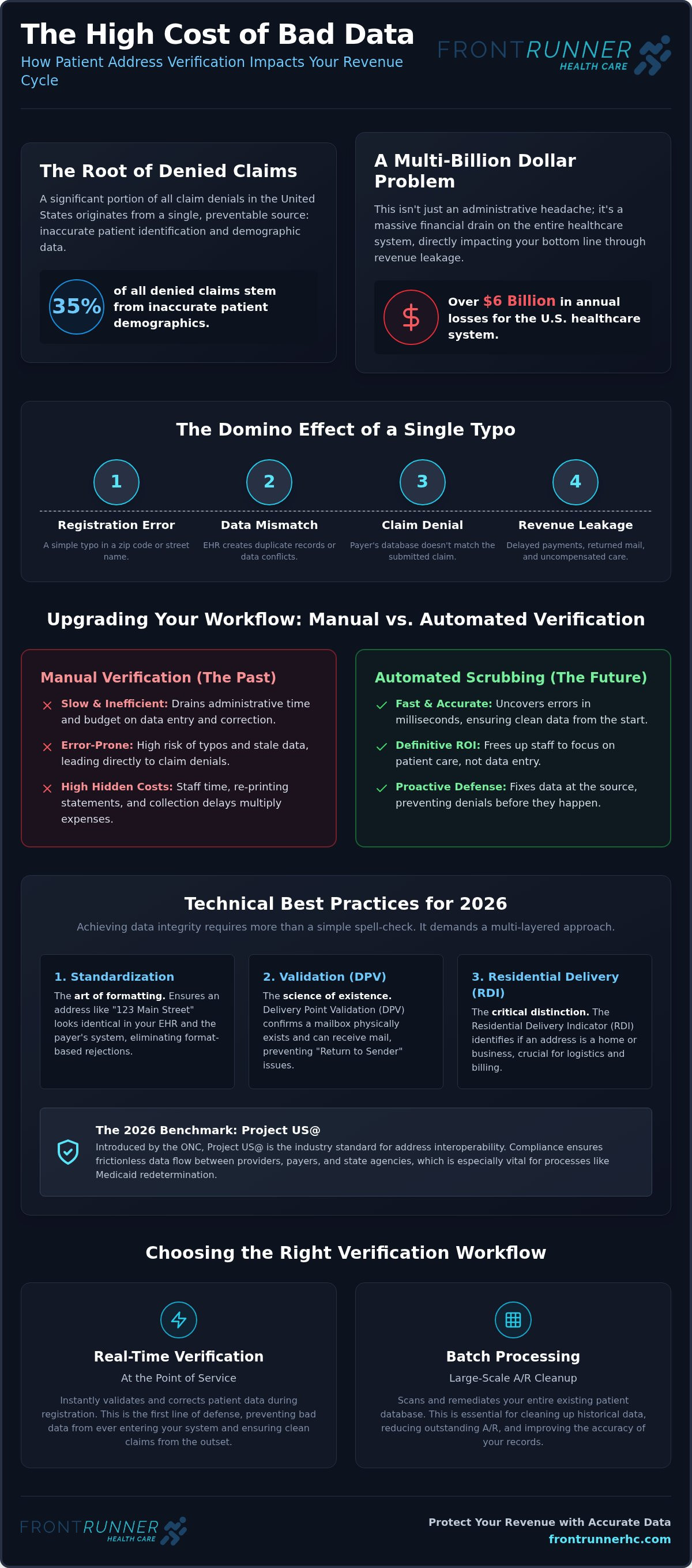
Did you know that 35% of all denied claims in the United States stem from inaccurate patient identification? It's a staggering figure that translates to over $6 billion in annual losses for the healthcare system. When a billing statement bounces back or a claim is rejected due to a simple demographic mismatch, your revenue cycle takes the hit. Implementing best practices for patient address verification isn't just about clean data. It's a financial clearance necessity and your first line of defense against revenue leakage.
We understand the daily chaos of manual registration and the frustration of stale data slowing down your patient throughput. You're working harder to capture every dollar, yet returned mail and uncompensated care continue to drain resources. This guide will show you how to eliminate claim denials by adopting automated demographic scrubbing. We'll explore the transition to 2026 healthcare data standards, the recent USPS API shifts, and how tools like PatientRemedi transform your front-end workflows into a high-speed defense against administrative waste. By the end, you'll have a clear roadmap to optimize accuracy and accelerate your organization's financial performance.
Table of Contents
The Strategic Impact of Patient Address Verification on the Revenue Cycle
Patient address verification is often dismissed as a back-office formality. It's actually a foundational pillar of clinical and financial data integrity. A single typo in a zip code or a missing apartment number triggers a destructive domino effect. It starts at registration, flows through the EHR, and eventually results in a hard denial from the payer. For providers aiming to hit 2026 RCM goals, understanding the impact of incorrect patient demographics on billing is critical. In high-volume environments like diagnostic labs, relying on manual entry is a recipe for revenue leakage. Automation offers a definitive ROI by replacing stale manual checks with real-time accuracy.
Manual verification is a slow, error-prone process that drains your administrative budget. In high-volume settings, the cost of staff manually correcting addresses can exceed the cost of the original service. Automated workflows eliminate this friction. They uncover errors in milliseconds, allowing your team to focus on patient care instead of data entry. This shift defends your resources and ensures that your revenue cycle remains fluid and predictable.
Beyond Deliverability: Why Claims Depend on Address Accuracy
Payers don't just use addresses to mail checks. They use this data as a primary identity marker for eligibility. If the address on file doesn't match the payer's database, the claim is often rejected immediately. This data also plays a vital role in preventing duplicate patient records. When addresses aren't standardized, the EHR might create a second profile for the same patient, fragmenting the clinical history and complicating the billing process. Utilizing an Address Verification Service (AVS) ensures that data is scrubbed against official databases before it enters your system. In this context, a clean claim rate is the percentage of medical claims that are successfully processed and paid on the first submission because all demographic data was accurate from the start.
The Hidden Cost of 'Return to Sender' in Healthcare
The financial drain of returned mail goes far beyond the price of a stamp. You're paying for the staff time required to research the correct address, the cost of re-printing statements, and the delay in your collection cycle. These errors are a primary driver of uncompensated care. When a patient never receives their bill, they can't pay it. Following best practices for patient address verification helps you capture these errors at the digital front door. This proactive approach is a core component of modern healthcare data remediation software, which focuses on fixing data at the source rather than chasing it down after a denial.
Standardizing vs. Validating: Technical Best Practices for 2026
Standardization is the art of formatting. Validation is the science of existence. In 2026, your revenue cycle can't survive with one without the other. Standardization ensures that "123 Main Street" looks the same in your EHR as it does in the payer's database. Validation, specifically Delivery Point Validation (DPV), confirms that the mailbox actually exists and can receive a statement. For providers, best practices for patient address verification mean moving beyond basic zip code checks. You also need Residential Delivery Indicators (RDI). These indicators tell you if an address is a home or a business. It's a critical distinction for home-health logistics, telehealth equipment delivery, and even identifying potential billing issues before they occur.
Relying on "good enough" data is a gamble you don't have to take. Technical precision at the point of registration prevents the administrative chaos of chasing down patients weeks after their visit. When you validate an address, you're confirming the patient's identity and their ability to fulfill their financial responsibility. It's a proactive step that protects your bottom line and respects the patient's time.
Project US@ and Interoperability Standards
The ONC introduced Project US@ to solve the "messy data" problem that has plagued healthcare for decades. It's now the 2026 benchmark for address interoperability across the industry. When every system speaks the same language, data flows without friction between providers, payers, and state agencies. This is especially vital during Medicaid redetermination cycles. If your records don't match the state's formatted data, patients risk losing their coverage. High-quality, standardized data is the engine behind effective medicaid redetermination assistance software. It ensures that outreach reaches the patient the first time, preventing unnecessary gaps in care and revenue loss.
The Role of Multi-Source Data Scrubbing
Relying on a single database like the USPS isn't enough for today's transient patient populations. Patients move, change names, and often have multiple active addresses. Multi-source scrubbing compares your patient records against a wider net of data, including utility records, property tax files, and credit headers. This process uncovers "stale" information that a single-source check might miss. By enriching these records, you gain a clearer picture of the patient's financial disposition. This technical sophistication is why many organizations are turning to Demographic Verification tools to automate the heavy lifting. Scrubbing isn't just about cleaning; it's about optimizing your data for maximum reimbursement and minimal administrative waste. It replaces guesswork with precision, ensuring your staff spends less time on corrections and more time on high-value tasks.
Evaluating Real-Time vs. Batch Verification Workflows
Choosing between real-time and batch verification isn't a matter of preference. It's a matter of operational strategy. Real-time tools act as a filter at the front door, while batch processes serve as a deep-cleaning mechanism for your database. To truly master best practices for patient address verification, you must deploy both strategically. This dual approach balances the need for immediate staff efficiency with the necessity of long-term data integrity. By embedding these checks into your patient registration workflow automation, you ensure that accuracy isn't an afterthought. It becomes a native part of every patient interaction. You're not just checking a box; you're defending your revenue cycle from the start.
We've seen how manual processes lead to exhaustion and error. A tiered workflow removes that weight. It allows your team to move quickly without sacrificing the depth of the data they collect. When the system handles the scrubbing, your staff can focus on the patient.
Point-of-Service (POS) Verification: Stopping Errors at the Door
Implementing address auto-complete is one of the simplest ways to accelerate intake. It reduces keystrokes and minimizes the potential for human error during high-pressure registration periods. Beyond the technical speed, there's a significant psychological benefit to verifying data while the patient is present. It establishes a culture of precision. When your staff can confirm "Is this still your current residence?" with a validated address on the screen, it builds trust. These real-time checks accelerate the entire financial clearance process by ensuring that the very first claim sent is based on "fresh" data. You aren't chasing a patient for a correct zip code weeks after they've left the facility. You're securing the payment path before they even see the provider.
Batch Scrubbing for A/R Recovery
Batch scrubbing is your primary tool for accounts receivable recovery and backlog management. It's essential when preparing for a major system migration or when your "return to sender" pile starts to impact your bottom line. These tools work behind the scenes to refresh thousands of records simultaneously, uncovering current data that manual teams could never find at scale. This process is particularly effective when used alongside retroactive insurance discovery software. If an address was wrong, your previous insurance search likely failed. Batch scrubbing identifies 'lost' patients by cross-referencing their old, stale profiles with updated multi-source residency data to find their current location for billing outreach. It breathes life back into old claims and turns administrative waste into recovered revenue.
Step-by-Step Guide to Implementing Address Verification Best Practices
Moving from manual chaos to automated precision requires a deliberate roadmap. It's not just about installing software; it's about re-engineering your culture to value data as a financial asset. To implement best practices for patient address verification, you must first audit your current denial codes. Look specifically for rejections related to demographic mismatches or "patient not found" errors. This audit reveals the exact size of your revenue leakage and provides the baseline for measuring your success. Once you've identified the gaps, you can move through the implementation process with clarity and purpose.
Step two involves selecting a partner with healthcare-specific API integrations. Generic tools designed for eCommerce shipping often lack the nuance required for clinical environments. You need a system that understands the complexities of patient identity. After selecting your partner, focus on training your front-desk staff. They need to understand the "why" behind data accuracy. When a registrar realizes that a single typo can delay a provider's payment for months, their mindset shifts from "data entry" to "revenue integrity."
Automation is the fourth step. Trigger your scrubbing process during the initial registration and again immediately before claim submission. This double-layered approach catches errors that might have been introduced during a patient's stay. Finally, establish an exception-handling protocol. Some addresses, like rural routes or temporary shelters, won't always fit standard validation molds. Your team needs a clear, documented workflow to handle these cases without slowing down patient throughput. To see how these steps fit into your specific environment, you can explore our Demographic Verification solutions.
Optimizing the Patient Registration Interface
Healthcare intake is significantly more complex than a standard retail transaction. While "guest checkout" logic works for online shopping, it fails in healthcare where longitudinal data is vital. However, we can still learn from eCommerce by using auto-fill technology. This reduces field fatigue for patients during digital intake and minimizes the chance of manual errors. When displaying validated address suggestions, HIPAA compliance is your priority. Ensure that your interface only displays enough information to confirm the match without exposing sensitive patient details to unauthorized eyes.
Staff Training and Change Management
Successful implementation depends on your team's buy-in. You're asking them to move away from "stale" manual habits toward a high-speed, automated future. Use a patient registration data quality checklist to maintain standards across every shift. Defining clear KPIs is essential for long-term success. Track your returned mail rates and front-end rejection numbers monthly. When staff see the direct correlation between their accuracy and the organization's financial health, the new workflow becomes a point of professional pride rather than an administrative burden.
Streamline Healthcare Demographic Verification with FrontRunnerHC, Inc.
Implementing the technical standards and workflows we've discussed requires more than just a policy change. It requires a platform built for the complexities of the modern revenue cycle. FrontRunnerHC, Inc. provides the "boots-on-the-ground" support and sophisticated technology needed to turn best practices for patient address verification into a daily reality. We don't just offer a software login; we act as a strategic partner to ensure your implementation is seamless and your results are measurable. By integrating our Demographic Verification tool directly into your existing RCM workflows, we help you replace manual guesswork with automated precision. The outcome is clear: fewer denials, faster reimbursement, and a friction-free experience for your patients.
Administrative burden shouldn't be the baseline for your staff. We've seen how manual data entry leads to burnout and revenue leakage. Our approach automates the heavy lifting. It allows your registrars to focus on the person in front of them while the system ensures the data behind the scenes is "fresh" and accurate. It's about defending your resources and optimizing your time.
Automated Data Remediation: The PatientRemedi Advantage
PatientRemedi is our definitive solution for automated demographic scrubbing. It goes far beyond simple postal checks by uncovering hidden errors that basic validation tools often miss. While standard services might confirm a zip code exists, PatientRemedi cross-references multiple data sources to ensure the identity and address match perfectly. This methodical cleanup moves your organization from the chaos of returned mail to a state of clinical and financial order. Having a single platform for address, insurance, and identity verification means your team doesn't have to toggle between multiple screens. Everything they need to secure a clean claim is available in one streamlined workflow.
Strategic Partnership for Long-Term RCM Health
FrontRunnerHC, Inc. is more than a software vendor. We're a strategic partner dedicated to the long-term health of your revenue cycle. We understand that every organization has unique friction points, which why our implementation team works closely with you to tailor our tools to your specific needs. By reducing the administrative burden on your staff, we empower them to focus on high-value tasks and patient care. We've built a better way forward that values order over chaos and precision over guesswork. Don't let stale data continue to drain your resources. Streamline your healthcare demographic verification with FrontRunnerHC, Inc. today.
Secure Your Revenue Cycle with Data Precision
We've explored how a single typo triggers a domino effect of denials and how adopting 2026 standards like Project US@ can stop revenue leakage at the door. By balancing real-time point-of-service checks with deep-cleaning batch scrubs, you move your organization from the frustration of returned mail to a state of clinical and financial order. Implementing best practices for patient address verification is no longer optional. It's the foundation of a modern, efficient revenue cycle that respects both your staff's time and your patient's journey.
FrontRunnerHC is here to help you navigate these complexities as a strategic partner. Our focus is purely on revenue recovery and expert-led RCM optimization, never direct debt collection. With PatientRemedi, you gain access to automated demographic scrubbing that uncovers errors before they impact your bottom line. It's time to replace stale, manual processes with a high-speed defense against administrative waste. Streamline your healthcare demographic verification with FrontRunnerHC's PatientRemedi. You have the power to transform your data into a financial asset and build a more resilient organization today.
Frequently Asked Questions
What is the difference between address validation and address verification in healthcare?
Validation confirms that an address is a deliverable location according to postal standards. Verification goes a step further by matching that address to a specific patient's identity. In healthcare, simply knowing an address exists isn't enough. You must confirm it's the correct residence for the individual being treated. This distinction is a core part of best practices for patient address verification to ensure billing accuracy and reduce returned mail.
How does incorrect address data lead to healthcare claim denials?
Payers use address data as a primary identity marker during eligibility verification. When the address on a claim doesn't match the payer's database, the system triggers an automatic rejection. This mismatch accounts for a large portion of the 35% of denials caused by inaccurate patient identification. Incorrect data also leads to returned mail. This delays patient payments and increases the volume of uncompensated care your organization must manage.
What is Project US@ and why should my healthcare organization care?
Project US@ is the 2026 technical standard for standardizing patient addresses across the healthcare industry. It was developed by the ONC to improve data interoperability and patient matching. By adopting this standard, your organization ensures that address data is consistent across different EHRs and payers. This reduces administrative friction, minimizes duplicate records, and supports smoother Medicaid redetermination processes. It ensures all systems speak the same formatting language for better data exchange.
Can automated address verification integrate with my existing EHR/EMR system?
Yes, solutions like Demographic Verification integrate directly into your existing EHR or EMR workflows via API. This allows for real-time data scrubbing at the point of registration without requiring staff to switch screens. Automated systems like PatientRemedi can trigger at intake or immediately before claim submission. This ensures that only "fresh," validated data enters your billing cycle. It significantly reduces the manual burden on your administrative team and speeds up reimbursement.
How often should a provider scrub their patient demographic database?
Providers should implement a dual-layered approach to scrubbing. Real-time verification should occur at every point of service to catch errors at the source. Additionally, performing a batch scrub of your entire database on a quarterly or semi-annual basis is one of the best practices for patient address verification. This periodic cleanup identifies patients who have moved or changed names. It ensures your legacy records remain accurate for future outreach and billing.
Does address verification help with Medicaid redetermination?
Address verification is essential for successful Medicaid redetermination. If a patient's address is outdated or formatted incorrectly, they won't receive renewal notices from the state. This leads to gaps in coverage and increased uncompensated care. Using RedeterminationAssist alongside address verification ensures you have the correct contact information to help patients maintain eligibility. This proactive step prevents unnecessary rejections and protects your revenue cycle from the chaos of coverage loss.
What happens if a patient's address cannot be verified by the USPS database?
When the USPS database fails to verify an address, FrontRunnerHC utilizes multi-source data scrubbing to find a match. We cross-reference secondary sources like utility records and property tax files to uncover "fresh" data. This is a key feature of PatientRemedi, which focuses on automated data remediation. This comprehensive approach ensures you don't lose the ability to bill just because one database is incomplete, specifically helping with transient populations or new developments.
Is real-time address verification better than batch processing for hospitals?
Neither is inherently better; they serve different strategic purposes. Real-time verification is superior for stopping errors at the digital front door during patient intake. Batch processing is more effective for accounts receivable clean-up and preparing for system migrations. Hospitals find the most success by combining both methods. This ensures that new patients are registered accurately while legacy data is periodically refreshed to maximize total revenue recovery and minimize administrative waste.


Comments