


Secondary Insurance Discovery Software: Maximizing Revenue Recovery in 2026
- FrontRunnerHC

- 2 days ago
- 12 min read
If you believe your rising uncompensated care costs are an unavoidable cost of doing business, you're likely overlooking a massive data remediation opportunity. Most "self-pay" accounts aren't actually uninsured; they're simply cases where the right coverage remains hidden behind broken data and complex Coordination of Benefits (COB) logic. By implementing patient insurance verification automation, you can stop the manual hunt for missing info that currently bogs down your staff. You've felt the frustration of denials and the weight of growing A/R days. It's a cycle that demands a more sophisticated, data-driven response.
This guide shows you how to break that cycle and maximize revenue recovery in 2026. We'll explore how advanced Insurance Discovery tools identify secondary and tertiary payers with surgical accuracy, turning potential bad debt into realized revenue. You'll learn how to master COB logic and use PatientRemedi to ensure demographic integrity from the start. We're moving past the chaos of manual verification and into a future of clean claims and predictable cash flow. It's time to recover the resources your facility has already earned.
Table of Contents
The Revenue Impact of Undiscovered Secondary Insurance
In the high-stakes environment of 2026 revenue cycle management, the label "Self-Pay" is frequently a mask for missed opportunities. It suggests a lack of coverage when, in reality, the patient often holds secondary or tertiary insurance that remains uncaptured at the point of service. Secondary insurance discovery is a strategic revenue recovery tool designed to identify and verify payer coverage that exists beyond the patient’s primary policy. Without it, providers are essentially leaving money on the table while administrative costs climb.
Uncompensated care continues to erode hospital margins, forcing administrative teams to do more with less. When primary claims are processed, any remaining balance often defaults to the patient. This shift triggers a costly, manual collection process that yields notoriously low returns. By leveraging patient insurance verification automation, organizations can pivot from chasing patients to billing verified payers. This isn't just about efficiency; it's about protecting the financial health of the institution. Every undiscovered secondary policy represents a direct hit to the bottom line that could have been avoided with better data.
The Hidden Leakage in Your A/R
The gap between a primary insurance payment and the total balance is where revenue leakage thrives. For high-volume labs and health systems, manual secondary searches fail at scale. Human error and the sheer volume of accounts make it impossible to check every national payer network. This creates a systemic blind spot. Integrating patient insurance verification automation into the early stages of the billing cycle ensures that these secondary payers are caught before the claim ever leaves the office. Automated discovery eliminates this friction by querying hundreds of payers simultaneously, ensuring that no potential coverage goes overlooked. It transforms a reactive billing process into a proactive recovery engine. By identifying these payers before an account hits the A/R, you reduce days in accounts receivable and improve cash flow.
The Medicaid Redetermination Factor
The 2026 landscape is defined by the continued shifts following the Medicaid redetermination "unwinding." Thousands of patients have transitioned from Medicaid to commercial plans or found themselves in complex primary-secondary splits. These coverage transitions are a primary source of claim denials. Utilizing medicaid redetermination assistance software allows providers to identify these new payers in real-time. It prevents the "coverage gap" denials that occur when a patient’s profile changes without notice. By automating this identification, you ensure that every claim is routed to the correct payer, maintaining the integrity of your clean claim rates even during periods of extreme market volatility. This proactive approach saves your staff from the "rework cycle" that kills productivity.
How Automated Secondary Insurance Discovery Software Functions
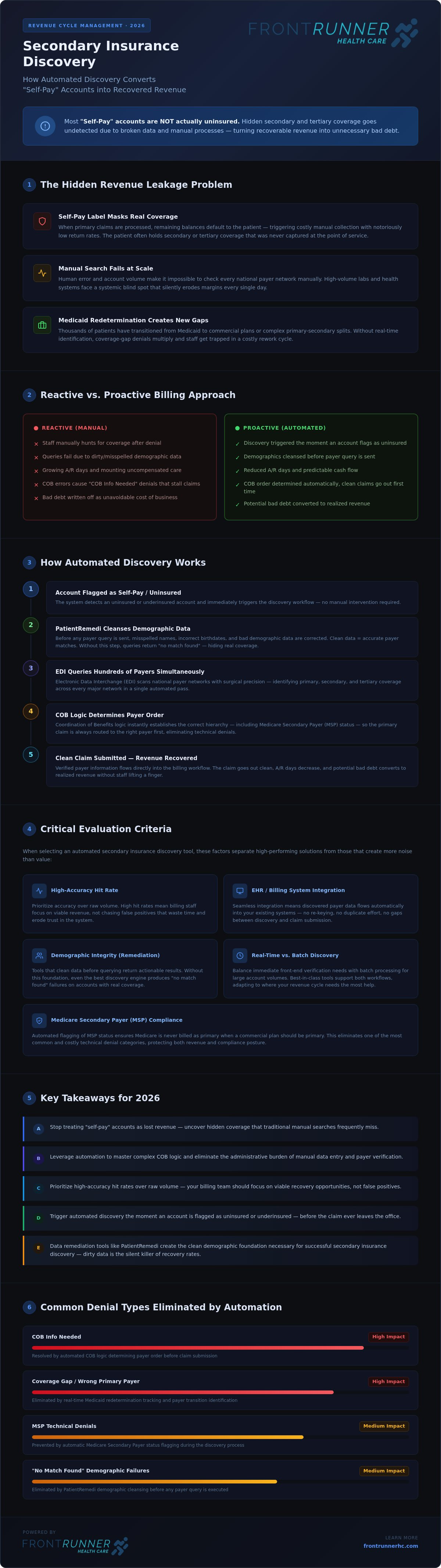
Effective insurance discovery isn't a simple search; it's a sophisticated data remediation exercise. Many legacy systems fail because they query payers using "dirty" data, leading to missed matches and lost revenue. Modern patient insurance verification automation changes this by utilizing Electronic Data Interchange (EDI) to scan national payer networks with surgical precision. This technology doesn't just look for a policy number. It identifies the specific hierarchy of coverage, including Medicare Secondary Payer (MSP) status, to ensure the primary claim is routed correctly from the start. By automatically flagging when Medicare should be secondary to a commercial plan, the software eliminates one of the most common causes of technical denials.
Mastering Coordination of Benefits (COB)
Automating Coordination of Benefits (COB) logic is the only way to handle the volume of today’s healthcare environment. When software identifies multiple payers, it must instantly determine the order of responsibility. This proactive approach significantly reduces "COB Info Needed" denial codes that typically stall the revenue cycle. A key differentiator here is how PatientRemedi cleanses demographic data before a query is even sent. By fixing misspelled names or incorrect birthdates, the software ensures that payer queries return accurate, actionable results rather than frustrating "no match found" errors. This clean data foundation is what allows for the seamless identification of secondary and tertiary payers without manual intervention.
Real-Time vs. Batch Discovery Workflows
Providers must balance immediate front-end needs with long-term back-end recovery. Real-time discovery happens during registration, allowing staff to verify coverage before the patient even leaves the office. This is critical for preventing uncompensated care at the point of entry. In contrast, batch processing is essential for clearing through backlogged claims or "self-pay" accounts that have already been coded as bad debt. Using a retroactive insurance discovery software approach helps your team recover revenue from accounts that were previously written off. This two-pronged strategy ensures that no coverage slips through the cracks, regardless of where the account sits in the billing cycle. Checking your backlog against these automated tools is a practical way to stabilize your A/R and uncover hidden revenue without adding to your team's workload.
Evaluating Secondary Discovery Tools: Key Features and Capabilities
Selecting a partner for patient insurance verification automation requires looking beyond surface-level dashboards. You need a solution that balances broad reach with extreme precision. While high hit rates look impressive on paper, they're a liability if they're riddled with false positives. Your billing team shouldn't waste hours chasing coverage that doesn't exist. The ideal tool identifies actionable secondary and tertiary payers while integrating seamlessly with your current EHR or LIS platforms. It should simplify your life, not add another layer of manual review to an already congested workflow.
Payer Connectivity and Network Depth
A "national" network is the minimum requirement, but true value lies in a tool's ability to reach regional and niche commercial payers that often fly under the radar. Your discovery software must provide a comprehensive "all-payer" search that encompasses Medicare, Medicaid, and private commercial plans simultaneously. This breadth ensures that even the most complex patient profiles are fully mapped and no potential revenue source is ignored.
Effective tools combine this discovery with real-time eligibility verification. It isn't enough to just find a policy; the system must confirm it's active and determine the exact benefit structure. This dual-action approach prevents the frustration of billing a policy that was terminated months ago. By leveraging AI to predict likely coverage patterns based on historical data, these systems prioritize the most probable payers. This logic accelerates the path to payment and keeps your revenue cycle moving at a steady pace.
Data Integrity and Demographic Scrubbing
Insurance discovery fails when patient demographics are "dirty." If a name is misspelled or an address is outdated, the payer's system will return a "no match" error, even if the coverage is active. This is where the synergy between discovery and demographic verification becomes critical. You cannot have successful patient insurance verification automation without a clean data foundation. They're two sides of the same coin.
The best solutions include automated demographic scrubbing to fix these discrepancies before the query is ever sent. By correcting a transposed digit in a social security number or a missing apartment number, tools like PatientRemedi ensure that your discovery queries have the highest possible chance of success. This isn't just a "nice-to-have" feature; it's the engine that drives high hit rates. When your data is accurate, your clean claim rate improves and your staff spends less time on manual remediation. It turns a chaotic process into a predictable, efficient revenue stream.
Integrating Discovery Automation into Your Billing Workflow
Successful integration of discovery tools requires a shift from manual searching to a rules-based, automated pipeline. It isn't enough to have the technology; you must embed it into the daily rhythm of your billing office. By setting specific triggers within your workflow, you ensure that every potential revenue leak is plugged without requiring a single click from your staff. This systematic approach transforms patient insurance verification automation from a standalone tool into a core component of your revenue cycle strategy.
The process follows a logical four-step sequence designed for maximum recovery:
Automated Triggering: Accounts are instantly pushed to discovery the moment they are classified as "Self-Pay" or "Partial Pay" after a primary insurance payment.
Real-Time Verification: Once the software identifies a potential secondary payer, it performs an immediate eligibility check to confirm the policy is active and relevant to the date of service.
COB Record Update: The discovered insurance information is automatically written back to the patient record, ensuring the Coordination of Benefits (COB) hierarchy is accurate for all future claims.
Secondary Filing: With verified data in hand, the system prepares the claim for secondary filing or primary resubmission, moving the account toward a final resolution.
Eliminating the "Self-Pay" Bucket
The "Self-Pay" bucket is often a catch-all for missing data rather than a true reflection of a patient's financial status. By automating the discovery of secondary coverage, you move these patients into a billable status, significantly reducing the burden on your financial counseling teams. This process, known as financial disposition, helps you determine the most effective next action for every claim. It’s a more empathetic approach that prioritizes finding a payer over requesting payment from an individual who may already have coverage they don't know how to use. When you find the right payer, everyone wins.
Optimizing Accounts Receivable Recovery
Beyond the front-end, discovery automation is a powerful engine for accounts receivable cleanup healthcare. It allows your team to revisit aged claims that were previously written off as uncollectible. You can recover this revenue without resorting to aggressive debt collection practices, which preserves patient relationships and protects your brand reputation. Because the software works at scale, it can scan your entire backlog to find coverage within payer-specific timely filing limits. This proactive cleanup ensures that you capture every dollar earned, even from accounts that have been sitting in A/R for months. To see how these workflows can stabilize your cash flow, explore our Insurance Discovery solutions today.
The FrontRunnerHC, Inc. Advantage: PatientRemedi and Advanced Discovery
Generic discovery tools often fail because they attempt to find coverage using the same flawed data that caused the initial denial. We take a different path. At FrontRunnerHC, Inc., we recognize that insurance discovery is only as effective as the data driving it. Our approach to patient insurance verification automation prioritizes data integrity above all else. We don't just search for policies; we remediate the underlying patient profiles to ensure your queries actually return results. This is the difference between a tool that adds to your noise and a solution that adds to your bottom line.
PatientRemedi: More Than Discovery
Fragmented healthcare data is the primary barrier to clean claim submission. When patient information is incomplete or inaccurate, even the most robust payer networks will return a "no match" response. This is why healthcare data remediation software is a critical prerequisite for successful discovery. PatientRemedi functions as the engine of accuracy, scrubbing and correcting demographics before the discovery process even begins. It fixes the transposed numbers, misspelled names, and outdated addresses that lead to technical denials.
PatientRemedi accelerates the reimbursement cycle by ensuring every claim is backed by verified, accurate demographic and insurance data from the first submission. By creating this clean data foundation, we significantly improve discovery hit rates. You aren't just finding more insurance; you're finding the right insurance with a higher degree of certainty. This synergy between data remediation and discovery turns "self-pay" accounts into billable claims with minimal manual effort.
A Strategic Partner for RCM Excellence
We understand the unique pressures faced by diagnostic labs and high-volume healthcare providers. These organizations often deal with massive quantities of data and limited direct patient contact, making accurate patient insurance verification automation even more vital. FrontRunnerHC, Inc. moves beyond the traditional vendor relationship to act as a strategic partner. Our team works with you to customize discovery rules that align with your facility's specific payer mix and billing requirements. We help you navigate the chaos of the industry with a no-nonsense approach that values your time and resources.
Our commitment to maximizing your reimbursement is grounded in practical utility. We focus on finding verified payers to satisfy balances, completely eliminating the need for aggressive patient debt collection. This protects your patient relationships while securing your financial future. We provide the intelligence and precision needed to transform your revenue cycle from a source of frustration into a model of efficiency. It's time to replace guesswork with a data-driven strategy that works. Schedule a demo of the FrontRunnerHC, Inc. Insurance Discovery solution today.
Securing Your Revenue Cycle for 2026 and Beyond
The transition to patient insurance verification automation isn't just about finding missing policies; it's about establishing a foundation of data integrity that prevents revenue leakage before it starts. You've seen how PatientRemedi data remediation logic transforms "dirty" demographics into actionable queries, ensuring your team isn't chasing ghosts. By mastering real-time COB verification, your organization can move past the administrative friction of manual searches and technical denials. It's about working smarter, not harder.
We've established that uncompensated care doesn't have to be an accepted loss. You can recover revenue from aged claims and "self-pay" accounts through a no-debt-collection revenue recovery model. This approach protects your patient relationships while stabilizing your cash flow. It's time to replace the guesswork of manual processes with the precision of a strategic partner who understands your administrative burdens. Request a Demo of our Secondary Insurance Discovery Software today and start uncovering the hidden coverage your facility has already earned. Your path to a cleaner, more efficient revenue cycle starts here.
Frequently Asked Questions
What is secondary insurance discovery software?
Secondary insurance discovery software is a specialized RCM tool that identifies additional coverage beyond a patient's primary policy. It scans national payer networks to find secondary or tertiary plans not captured at registration. By using patient insurance verification automation, providers convert "self-pay" balances into billable claims. This process ensures all available resources are exhausted before billing the patient directly, protecting both the provider's revenue and the patient's financial experience.
Can automated software find secondary insurance with only a patient name and DOB?
Yes, although the success rate improves significantly when demographics are accurate. While name and date of birth are core identifiers, advanced systems like PatientRemedi first verify and scrub this data to correct errors. Once the demographics are clean, the software queries hundreds of payers to uncover active policies. This automated approach is much more effective than manual searches, which often fail due to minor data entry mistakes or incomplete patient records.
How does secondary insurance discovery differ from primary discovery?
Primary discovery identifies a patient's main coverage when they are uninsured. Secondary discovery goes deeper by looking for supplemental policies covering balances after the primary payer processes the claim. This requires sophisticated logic to understand how different plans interact. It is a critical part of patient insurance verification automation because it prevents accounts from defaulting to self-pay status when a secondary payer could have covered the remaining balance.
Is secondary insurance discovery software compatible with my EHR?
Most modern discovery solutions are designed to integrate seamlessly with leading EHR and LIS platforms. Integration allows for automated triggers where the software runs a search the moment an account is flagged as self-pay. The discovered coverage is then written back to the patient record, minimizing manual data entry for your billing team. This bi-directional flow ensures that your staff always has the most current insurance information available without leaving their primary workflow.
What is the typical hit rate for secondary insurance discovery?
Hit rates vary based on your specific patient population and the accuracy of your initial data; however, many providers see a significant percentage of "self-pay" accounts matched with coverage. In the 2026 landscape, high-performing tools prioritize finding actionable, active policies rather than providing a high volume of false positives. Success depends on the depth of the payer network and the ability of the software to remediate demographic errors before searching.
How does the software handle Coordination of Benefits (COB) rules?
The software uses built-in logic to automatically determine the correct order of payers based on industry standards and specific plan types. It identifies which policy is primary and which is secondary, such as when a patient has both Medicare and a commercial plan. This automation reduces the "COB Info Needed" denials that often stall the revenue cycle. By establishing the correct hierarchy upfront, the system ensures claims are routed correctly the first time.
Does discovery software help with Medicaid redetermination?
Yes, it is an essential tool for navigating the coverage shifts caused by Medicaid redetermination. As patients lose Medicaid eligibility or transition to commercial plans, their coverage profiles change rapidly. Specialized tools like RedeterminationAssist help providers identify these new primary or secondary payers in real-time. This prevents the "coverage gap" denials that occur when a provider bills a terminated policy, allowing for a smoother transition and more predictable revenue recovery.
Can this software help recover revenue from old accounts receivable?
Absolutely. Many providers use discovery software for back-end accounts receivable cleanup to find coverage for aged claims previously written off as bad debt. The software can batch process thousands of old accounts to identify insurance that was active on the date of service. This allows you to recover revenue without resorting to aggressive debt collection, preserving patient relationships while successfully capturing funds that would otherwise be lost to uncompensated care.


Comments