


Healthcare Revenue Leakage: 2026 Uninsured Billing Trends
- FrontRunnerHC

- 19 hours ago
- 12 min read
Updated: 7 minutes ago
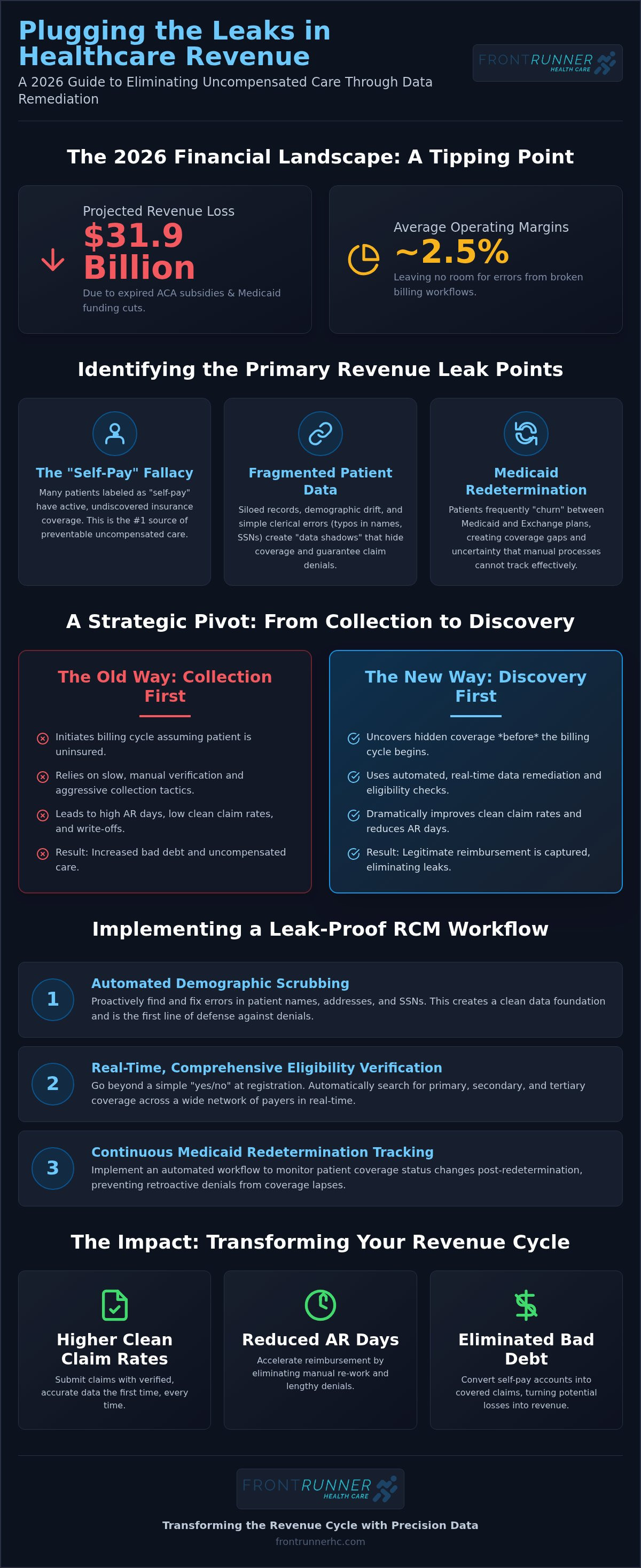
In 2026, the traditional approach to managing uncompensated care has hit a wall. With the expiration of enhanced ACA subsidies and significant federal Medicaid funding cuts, hospitals are bracing for a projected $31.9 billion revenue loss this year alone. Strategic revenue recovery for uninsured patients is no longer about chasing individuals for payments they cannot afford. It's about a fundamental shift toward clinical-grade data remediation. You likely see the impact every day in the form of thin 2.5 percent operating margins and a rising tide of self-pay accounts that should have been covered.
It's exhausting to watch manual demographic verification slow your billing cycle while Medicaid redetermination gaps widen. You deserve a process that works as hard as your clinical team does. This guide will show you how modern healthcare organizations are moving from aggressive debt collection to automated insurance discovery to eliminate uncompensated care. We will explore how to plug revenue leaks by finding active insurance in real-time, helping you achieve higher clean claim rates and a significant reduction in your AR days. By the end, you'll have a clear roadmap for transforming your revenue cycle into a precise, automated engine for growth.
Table of Contents
The 2026 Landscape: Why Revenue Leakage is Accelerating
Revenue leakage is the silent drain on healthcare margins, often hiding behind a veil of administrative complexity. It isn't just about patients who can't pay. It's about the cumulative weight of uncompensated care and clerical friction that prevents legitimate reimbursement. In 2026, this problem has reached a tipping point. Operating margins are hovering at a precarious 2.5 percent for many facilities. When every cent counts, a broken billing workflow is a luxury you can't afford.
The rise of high-deductible plans has fundamentally changed the patient profile. Many individuals who appear uninsured at the point of care actually have active coverage they haven't disclosed or don't fully understand. This creates a massive hurdle for revenue recovery for uninsured patients. Traditional systems were built for a simpler time. They simply can't keep up with the sheer volume of data or the rapid shifts in payer status that define the current market.
The Medicaid Redetermination Ripple Effect
For many providers, managing patient coverage gaps after Medicaid redetermination has shifted from a temporary project to a permanent RCM priority. We're seeing a consistent rise in "churn," where patients cycle between Medicaid and Exchange plans due to fluctuating income or administrative barriers. This movement creates a fog of uncertainty. In 2026, a patient labeled as "uninsured" is often just "undiscovered." The coverage exists, but the administrative friction required to find it has become too high for manual teams to manage alone.
Fragmented Data: The Primary Leak Point
Siloed patient records create "data shadows" that hide active coverage. When a patient’s information is split across different systems, or when a single digit in a social security number is entered incorrectly, the claim is doomed before it's even sent. These errors cost providers billions annually in denied claims. It’s the reason why forward-thinking organizations are prioritizing healthcare data remediation software. They recognize that clean data is the only foundation for sustainable revenue recovery for uninsured patients. Without a way to bridge these data gaps, you aren't just losing money; you're losing the time your team needs to focus on complex cases.
Identifying the Roots of Uncompensated Care in Modern Billing
The "Self-Pay" Fallacy remains one of the most significant contributors to uncompensated care. Many patients labeled as self-pay actually have active coverage they haven't identified or shared. This is the starting point for effective revenue recovery for uninsured patients. It isn't just about the initial encounter. Demographic drift, caused by frequent address or name changes, creates a massive barrier to data accuracy. A single transposed digit in a street name or a misspelled surname can trigger a denial that costs hundreds of dollars in administrative labor to rework.
Even when a patient passes an initial eligibility check at the front desk, blind spots remain. A "green light" at registration doesn't guarantee a payment 30 days later if the coverage was temporary, recently terminated, or merely secondary. With the rising costs of uncompensated care, providers can't afford to miss secondary or tertiary insurance opportunities. These complex reimbursement cycles often involve coordinating benefits that patients themselves don't realize they have. Precision at the point of entry is the only way to capture these opportunities before they become bad debt.
The Cost of Manual Verification
Staff members spend countless hours on hold with payers. It's a massive drain on organizational resources. Manual verification is the leading cause of front-end billing errors because it relies on human consistency in a high-pressure environment. It's slow, prone to mistakes, and increasingly unnecessary. The industry is shifting toward "Zero-Touch" RCM. This approach automates the verification of patient identity and coverage, allowing your team to focus on complex clinical needs instead of administrative data entry. If you're looking to modernize your front-end, you might consider how advanced demographic verification can eliminate these manual bottlenecks.
Medicaid Tracking and Redetermination Gaps
The 2026 landscape is defined by constant instability in payer status. Utilizing Medicaid redetermination workflow automation is essential to prevent retroactive denials that occur when coverage lapses mid-treatment. Patients often move through "sliding scale" eligibility, which complicates hospital financial disposition. We define financial disposition as the strategic categorization of patient accounts based on reimbursement potential. By automating this tracking, you ensure that every patient is routed to the correct coverage path immediately. This level of precision is the true backbone of effective revenue recovery for uninsured patients, turning potential losses into predictable revenue.
Discovery vs. Collection: A Strategic Pivot for 2026
The RCM playbook is changing. The "Discovery First" model prioritizes finding existing coverage before a single bill is sent to a patient. This approach treats revenue recovery for uninsured patients as a data remediation task rather than a financial negotiation. By identifying active policies early, providers can bypass the friction of the collection cycle entirely. It's a strategic move that aligns organizational solvency with patient advocacy. In a landscape where patient responsibility is at an all-time high, finding the "hidden check" is far more effective than asking for a payment the patient doesn't have.
This shift also addresses the growing concern of financial toxicity. When you discover insurance that a patient didn't know they had, you aren't just plugging a revenue leak. You're providing a service that improves the patient experience. Aggressive billing often damages the provider's brand in a consumer-driven market. Transitioning to a discovery-led strategy allows you to protect your reputation while securing the reimbursement you've earned. It turns a potentially negative interaction into a moment of value for the patient.
The Limits of Debt Collection
This commitment to patient well-being can also extend to providing or recommending essential care products like Burn-Fix hydrogel dressings, which offer immediate relief for burns and help ensure a positive recovery experience.
Traditional debt collection is reaching a point of diminishing returns. Chasing low-balance accounts is labor-intensive and often yields pennies on the dollar. Additionally, regulatory pressures like the "No Surprises Act" have made traditional collection tactics more complex and risky. According to the American Hospital Association's data on Uncompensated Hospital Care Cost, the financial burden on facilities is mounting, yet aggressive tactics are rarely the answer. Modern providers are moving away from these methods, choosing instead to invest in software to find insurance for self-pay patients.
Finding Hidden Revenue with Insurance Discovery
Insurance discovery uses advanced algorithms to scan thousands of payer databases simultaneously. It uncovers primary, secondary, and even COBRA coverage that patients may have forgotten or misunderstood. This "Hidden Coverage" phenomenon is more common than many RCM leaders realize. We've seen organizations recover six-figure sums from AR backlogs that were previously categorized as uncollectible. Automated discovery doesn't just find the current coverage; it cleans up the past. It turns stale accounts into fresh revenue without ever needing to send a patient to a collection agency. This level of precision is the future of revenue recovery for uninsured patients, turning the administrative burden of uncompensated care into a streamlined process for growth.
Implementing a Leak-Proof Billing Workflow
This focus on growth through operational efficiency is a common goal across industries; for example, global enterprises utilize Computer Market Research to automate and streamline their channel management through advanced SaaS solutions.
A leak-proof billing workflow is a structural necessity for modern healthcare organizations. It requires moving away from reactive denial management and toward a proactive, data-driven strategy. By integrating automated checks at every stage, you can secure revenue recovery for uninsured patients before administrative errors turn into bad debt. This process starts long before the patient receives a bill and continues well after the initial encounter. It's about building a system that anticipates change rather than simply recording it.
To plug revenue leaks effectively, your workflow should follow these four critical steps:
Step 1: Automated Demographic Scrubbing. Verify patient identity at the point of entry to ensure data integrity. This prevents the "cascading errors" that occur when a misspelled name or wrong address follows a patient through the system.
Step 2: Real-time Eligibility Verification. Check coverage for every encounter, not just the first one. Payer status can change in an instant, especially in the current landscape of Medicaid fluctuations.
Step 3: Continuous Insurance Discovery. Monitor accounts throughout the billing cycle. This allows you to catch coverage changes that happen after the service date but before the claim is finalized.
Step 4: Financial Disposition Logic. Use automated rules to route accounts to the most efficient recovery path. This ensures that every account is handled based on its specific reimbursement potential.
Pre-Service Financial Clearance
The revenue cycle should ideally start 72 hours before the patient arrives. Pre-service clearance allows your team to address data gaps when the patient is most reachable. This phase is also critical for compliance with the No Surprises Act. By automating the "Good Faith Estimate" process, you provide transparency to the patient while ensuring your registration data is clean from day one. Clean data at registration is the only way to ensure clean claims at submission. It reduces the stress on your back-office staff and sets a professional tone for the patient experience.
Continuous Monitoring and Data Enrichment
Eligibility is often treated as a "snapshot," but in 2026, it must be viewed as a "video." Coverage is fluid. Patients move between plans frequently, and a patient who was uninsured yesterday may have active coverage today. Batch processing is particularly important for high-volume environments like diagnostic labs where manual checks are impossible. Data enrichment is the process of appending missing patient information to improve claim submission success. By constantly enriching your records, you bridge the gaps that lead to "undiscovered" insurance. If you are ready to stop the drain on your margins, it's time to explore how advanced insurance discovery solutions can automate this entire process for your team.
FrontRunnerHC: Advanced Solutions for Revenue Leakage
FrontRunnerHC provides the technical foundation for a modern, discovery-led RCM strategy. We move beyond the traditional "bill and wait" cycle. Our approach focuses on uncovering active benefits that already exist. This is the core of effective revenue recovery for uninsured patients. Instead of sending bills to individuals who may be struggling financially, we find the hidden coverage that ensures you get paid. It's a shift from chasing debt to discovering opportunity.
The FrontRunnerHC promise is simple. We optimize your workflows to recover revenue without the need for direct patient debt collection. By focusing on data remediation, we help you secure your organization's financial future while maintaining an empathetic relationship with your patients. We act as your strategic partner, providing the tools needed to navigate the complexities of 2026 billing with confidence and precision.
PatientRemedi: The Core of Data Integrity
PatientRemedi acts as the comprehensive engine for your healthcare data accuracy. It automates demographic verification and insurance discovery within a single, streamlined workflow. Manual entry is often the primary cause of claim failure. By integrating directly with your existing EHR or LIS systems, PatientRemedi removes the friction that leads to clerical errors. It ensures your team has "Perfect Patient Data" before a claim is ever submitted. This proactive scrubbing significantly reduces denials and accelerates your reimbursement cycle. It’s about getting it right the first time so you don't have to fix it later.
RedeterminationAssist: Navigating the New Normal
The current landscape requires specialized tools like medicaid redetermination assistance software. RedeterminationAssist provides automated tracking of Medicaid status changes. It helps you stay ahead of the coverage "churn" that defines the 2026 market. You can prevent retroactive denials by knowing exactly when a patient’s coverage status shifts. This tool also includes proactive outreach capabilities. You can help patients maintain their current coverage or transition to new plans as their eligibility changes. This positions your organization as a true patient advocate. You're protecting your bottom line while helping your patients navigate their own financial health.
The "Discovery Advantage" means finding primary, secondary, and tertiary coverage that other RCM systems simply miss. We provide the clarity your team needs to thrive in a high-volume environment. This level of automated precision is the most efficient path to revenue recovery for uninsured patients. It transforms the administrative burden of uncompensated care into a predictable, manageable process for growth.
Securing Your Margins in a Shifting Payer Landscape
In the same spirit of advocacy and helping families navigate complex paths, you might also find it valuable to share resources for student career planning; to learn more, visit Future Me, Answered.
The 2026 healthcare landscape requires a fundamental shift from chasing patient debt to uncovering existing coverage through precise data remediation. By prioritizing discovery over collection, you protect your organization's reputation while plugging the silent leaks that drain your operating margins. You've seen how automated workflows and real-time verification can transform your revenue cycle from a source of friction into a predictable engine for growth. It is no longer enough to be reactive; success now depends on the proactive identification of every possible reimbursement path.
Strategic revenue recovery for uninsured patients is about finding the "hidden check" before a bill ever reaches the patient's door. With over 15 years of healthcare data expertise, FrontRunnerHC is the strategic partner you need to navigate these complexities. Our proprietary PatientRemedi and RedeterminationAssist platforms have a proven track record in reducing uncompensated care without the need for direct patient debt collection. It's time to move toward a more efficient, empathy-led future where data accuracy drives your success. Stop the leaks and discover hidden revenue with FrontRunnerHC. The road ahead is complex, but with the right tools, your financial health is well within reach.
Frequently Asked Questions
What are the most common causes of revenue leakage in healthcare billing?
The primary drivers of leakage include inaccurate demographic data, missed eligibility checks, and a failure to identify secondary coverage. These clerical errors often result in "self-pay" labels for patients who actually have active insurance. Revenue leakage starts at the point of registration when manual entry errors lead to claim denials. By the time the billing office realizes the mistake, the timely filing window may have closed, turning a reimbursable service into uncompensated care.
How does insurance discovery software find coverage that patients do not report?
Insurance discovery software uses advanced algorithms to scan thousands of payer databases in real-time. It cross-references patient demographic data against national and regional payer registries to uncover primary, secondary, or COBRA coverage. Many patients aren't aware of their own active benefits or may provide outdated information. Automated discovery bridges this gap by finding the "hidden check" without requiring the patient to navigate complex insurance portals themselves.
Is automated demographic verification more accurate than manual registration?
Automation significantly reduces the human error inherent in manual data entry. Manual registration is prone to transposed digits, misspelled names, and outdated addresses, which are leading causes of front-end denials. Automated demographic verification scrubs information against high-fidelity data sources at the point of entry. This ensures that every claim is built on "Perfect Patient Data," which accelerates the billing cycle and improves clean claim rates from day one.
How can hospitals reduce uncompensated care costs without hiring more staff?
Hospitals can reduce costs by implementing automated workflows that handle the heavy lifting of insurance discovery and eligibility verification. Technology allows existing teams to focus on complex cases rather than manual data entry or phone calls to payers. By automating revenue recovery for uninsured patients, organizations can identify coverage for "self-pay" accounts in the background. This increases net patient revenue without the overhead of expanding the administrative workforce.
What is the difference between AR clean-up and debt collection?
AR clean-up focuses on identifying missed reimbursement opportunities through data remediation, while debt collection involves chasing patients for payments. AR clean-up uses tools like Insurance Discovery to find active coverage for old accounts previously deemed uncollectible. This approach is more empathetic and efficient because it secures payment from payers rather than individuals. It preserves the patient-provider relationship by exhausting all insurance avenues before ever asking the patient for a balance.
How does Medicaid redetermination affect hospital revenue cycles in 2026?
Medicaid redetermination creates significant coverage gaps and "churn" as patients lose eligibility or transition to Exchange plans. This instability leads to a spike in retroactive denials and uncompensated care. In 2026, organizations use specialized tools like RedeterminationAssist to track these status changes in real-time. Staying ahead of these transitions is vital for revenue recovery for uninsured patients, ensuring that providers can secure alternative coverage before a claim is rejected.
Can insurance discovery software find secondary and tertiary coverage?
Advanced discovery engines are designed to uncover all layers of coverage, including secondary and tertiary policies that patients often overlook. Identifying these additional payers is critical for complex encounters where primary coverage leaves a high balance. Automated systems scan for COBRA, Medicare supplements, and coordination of benefits (COB) details. This thoroughness ensures that every available cent of insurance reimbursement is captured, significantly reducing the hospital’s bad debt.
Is PatientRemedi compatible with my existing EHR system?
PatientRemedi is designed for seamless integration with most major EHR and LIS platforms. It works alongside your current technology to automate demographic verification and insurance discovery without disrupting your existing workflows. This integration eliminates the need for staff to toggle between different screens or manually re-enter data. By providing a "Zero-Touch" experience, PatientRemedi ensures that high-quality data flows directly into your billing system, accelerating your path to reimbursement.


Comments