


Implementing Automated Medical Billing Audits: 2026 Strategy Guide

Did you know that manual billing audits catch less than 15% of errors? In an era where payers use sophisticated AI to scrutinize every line item, relying on human oversight is like defending a modern fortress with a wooden shield. You've likely felt the sting of increasingly aggressive denials and the high cost-to-collect that follows every rework. It's exhausting to watch hard-earned revenue vanish into a cycle of administrative delays. Implementing robust claim denial prevention software is no longer a luxury; it's a front-end requirement for survival.
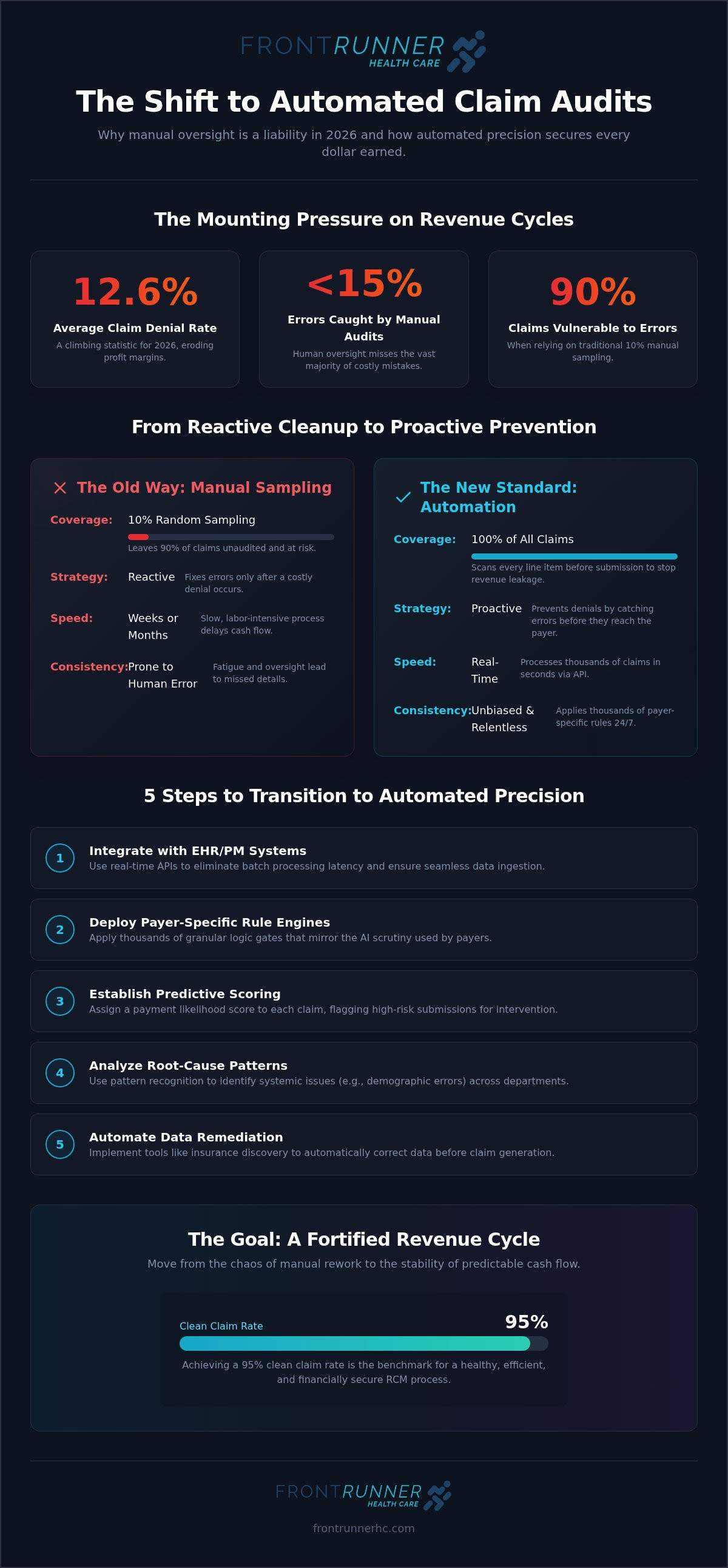
We understand the pressure of maintaining a healthy bottom line when the average claim denial rate has climbed to 12.6% in 2026. This guide will show you how to master the transition from manual oversight to automated precision to eliminate revenue leakage and secure every dollar earned. We'll explore how to leverage technology to navigate the 2026 CMS Interoperability mandates, reduce administrative burdens, and secure a 95% clean claim rate. It's time to replace the chaos of manual processes with the predictable cash flow your organization deserves.
Table of Contents
Why Automated Medical Billing Audits Are Critical in 2026
Automated medical billing audits represent a fundamental shift in how providers protect their financial health. Unlike traditional reviews that happen after a denial occurs, these audits use AI to scan 100% of claims for errors before they ever reach a payer. This is the core function of modern Revenue cycle management (RCM). By identifying technical glitches, coding mismatches, or eligibility gaps in real time, claim denial prevention software ensures that every submission is as close to "clean" as possible. It's about moving from a reactive "clean-up" mindset to a proactive "prevention" strategy.
Relying on manual 10% sampling is a significant financial risk in 2026. When you only check one out of every ten claims, you're essentially guessing about the health of your revenue stream. This "sampling liability" leaves 90% of your claims vulnerable to systemic errors that can lead to massive revenue leakage. Payers have already transitioned to aggressive, AI-driven scrutiny. They don't miss the small details. Your audit process shouldn't either. To survive in this environment, providers need equivalent technology to neutralize payer AI and prevent denials before they're even triggered. Silence on these undetected errors is expensive. It's the difference between predictable cash flow and a balance sheet riddled with "missing" revenue that was earned but never collected.
Manual vs. Automated Audits: The Efficiency Gap
The difference between manual and automated oversight is a matter of both scale and precision. Manual audits are slow and prone to human fatigue. A team might take weeks to review a month's worth of data, whereas automated systems process that same volume in seconds. This speed allows for immediate course correction. Scope is another critical factor. Moving from random sampling to 100% visibility means no error goes undetected. Automated systems apply thousands of payer-specific rules with absolute consistency. They don't have "off days" or overlook a documentation requirement because of a shift change. They provide a relentless, unbiased defense of your resources.
Regulatory Compliance in the 2026 Landscape
Compliance requirements are shifting rapidly as we move toward the 2027 IPPS regulatory drivers. Staying ahead of these changes requires data precision that manual workflows simply cannot provide. Automated audits ensure every claim meets evolving HIPAA and CMS documentation standards without adding to your staff's workload. Implementing RCM automation for specialty clinics is a strategic way to support this compliance. It creates a digital paper trail that is both audit-proof and highly accurate. This approach turns regulatory hurdles into a competitive advantage by ensuring your data foundation is solid before a claim is ever generated.
The Mechanics of High-Velocity Claim Denial Prevention Software
High-velocity claim denial prevention software operates like a high-performance engine. It doesn't wait for a claim to fail; it builds success into the workflow from the start. The process begins with seamless data ingestion. Modern platforms sync directly with EHR and PM systems via real-time APIs to eliminate the latency of batch processing. Once data enters the system, the rule engine takes over. It applies thousands of payer-specific logic gates to every line item. These aren't generic checks. They are granular requirements that mirror the exact AI scrutiny used by payers in 2026. This immediate validation ensures that errors are caught while the patient's file is still active, not weeks later after a rejection letter arrives.
The software then moves into predictive accuracy. It assigns a score to every claim based on its likelihood of immediate payment. If a claim falls below a certain threshold, it's flagged for intervention before submission. This is where pattern recognition becomes invaluable. The system identifies root-cause errors that span across departments, such as recurring demographic mismatches or missing clinical documentation. It turns isolated failures into actionable insights that improve the entire revenue cycle. Instead of chasing individual denials, your team can fix the systemic issues that cause them, significantly reducing the administrative burden on your staff.
Claim Scrubbing vs. Comprehensive Auditing
Basic claim scrubbers often fail because they only look for missing fields or simple formatting errors. They miss the nuances of medical necessity or complex payer-specific modifiers that trigger the most expensive denials. Comprehensive auditing goes deeper. It focuses on data integrity rather than just completion. Deep-tier auditing identifies potential underpayments by cross-referencing clinical data with contract terms. It ensures you aren't just getting paid; you're getting paid the full amount you earned. This transition from "missing fields" to "data integrity" is what separates high-performing billing teams from those struggling with stagnant cash flow.
Insurance Discovery as an Audit Foundation
An audit is only as effective as the underlying coverage data. If the patient's insurance information is stale or inaccurate, even the most perfect coding will result in a denial. This is why integrating retroactive insurance discovery software into your audit cycle is essential. It automates the search for secondary coverage and active primary plans that patients might have forgotten or failed to disclose. By aligning your data with the CMS Internet-Only Manuals, you ensure your process follows the highest standards of federal billing guidelines. When you optimize your data remediation before submission, you eliminate coordination of benefits (COB) denials at the source and secure your revenue foundation.
Solving the Denial Puzzle: Root Cause Analysis
Most healthcare organizations are stuck in a cycle of denial management. They wait for a rejection, then expend significant resources on rework and appeals. It's a reactive trap. Financial stability in 2026 requires a shift to denial prevention. By utilizing claim denial prevention software, you stop the cycle before it starts. This proactive approach identifies the specific triggers that lead to non-payment. In our current landscape, those triggers are remarkably consistent: eligibility failures, demographic inaccuracies, and the complexities of Medicaid redetermination. When you understand the root cause, you can fix the process, not just the claim.
Effective analysis requires categorizing errors into two distinct buckets: clinical documentation and administrative gaps. Clinical issues often require provider intervention or more detailed charting. Administrative gaps, however, are entirely avoidable. These are the technical "logic-gate" failures that should never leave your office. Aiming for a 95% clean claim rate isn't just an ambitious goal; it's the professional standard for a high-performing revenue cycle. Achieving this requires a relentless focus on data integrity at the front end. It transforms your billing department from a cost center into a predictable engine of growth.
The Demographic Data Gap
Small errors often lead to the largest financial leaks. Industry data shows that incorrect patient demographics cause 30% of all denials. A transposed digit in a zip code or a misspelled name can halt a payment for weeks, driving up your cost-to-collect. Automating identity and address validation before the audit phase is no longer optional. Demographic scrubbing is a powerful revenue recovery tool that ensures the "who" and "where" of every claim are accurate. It removes the human error that naturally occurs during a busy registration process, securing your path to reimbursement.
Real-Time Eligibility and Audit Workflows
Eligibility is the foundation of every successful claim. Integrating pre-service eligibility verification into your audit workflow eliminates the front-end errors that traditionally plague the back end. This is especially vital in 2026 as we manage the ongoing impact of Medicaid "unwinding." Automated redetermination tracking removes the guesswork from coverage status. It reduces the administrative burden of manual eligibility calls and ensures your staff isn't wasting time on claims for inactive policies. By leveraging claim denial prevention software to verify coverage in real time, you protect your time and resources from the chaos of shifting payer rolls.
5 Steps to Implementing an Automated Audit Workflow
Transitioning from manual oversight to automated precision isn't just a software installation. It's a strategic overhaul of your revenue cycle. To move away from the high cost-to-collect and the frustration of rework, you need a methodical roadmap. Implementing claim denial prevention software requires a shift in how your team perceives data integrity. It moves the focus from "fixing mistakes" to "preventing failures." By following these five steps, you can secure your revenue stream and ensure every claim is optimized for immediate payment.
Step 1: Audit your current denial landscape. Identify your high-frequency error codes to understand where your current process is failing. Are denials coming from technical glitches or clinical documentation gaps?
Step 2: Cleanse your data foundation. Use automated demographic and insurance discovery tools to fix coverage and identity errors before they enter the audit phase.
Step 3: Integrate via secure API. Connect your audit software directly into your existing EHR or PM system. This allows for real-time data flow and eliminates the latency of manual uploads.
Step 4: Conduct a "shadow audit." Run your new automated system alongside your manual checks for a set period. This validates the software's accuracy and builds confidence in the results.
Step 5: Establish a continuous feedback loop. Ensure that errors caught by the software are reported back to the front-desk staff. This prevents the same mistakes from recurring and improves data quality at the source.
Success in 2026 depends on your ability to act on data in real time. If you're ready to stop the leakage, you can automate your audit workflow today to protect your organization's financial future.
Selecting the Right Automation Partner
Choosing a partner is about more than just finding a vendor. You need a strategic ally that understands the difference between front-end vs back-end RCM software. Look for a platform solution that offers scalability rather than a point solution that only fixes one problem. Your partner must provide real-time insurance discovery, frequent payer rule updates, and strict HIPAA compliance. A partner that understands the nuances of 2026 regulations will ensure your claim denial prevention software remains effective as payer requirements evolve.
Training for Exception Management
Automation doesn't replace your staff; it elevates them. Training should focus on transitioning your team from repetitive data entry to high-level exception management. This requires a new set of KPIs to measure success. Instead of tracking the number of claims processed, focus on your clean claim rate, days in A/R, and the overall cost-to-collect. By defining these metrics clearly, you create a culture of data integrity. Your staff becomes a team of experts who resolve complex issues, while the software handles the high-volume, routine checks that previously led to burnout.
Future-Proofing RCM with FrontRunnerHC Data Remediation
Success in 2026 isn't just about catching errors; it's about fixing the data that causes them. FrontRunnerHC’s PatientRemedi™ platform fuels automated audit success by ensuring your data foundation is accurate before a claim is ever generated. While standard claim denial prevention software might flag a mismatch, PatientRemedi™ actually remediates the record. It uncovers "hidden" revenue through advanced insurance discovery technology, finding active coverage that patients or front-desk staff may have missed. This proactive approach transforms your revenue cycle from a series of guesses into a precision-guided operation.
Maintaining Medicaid data integrity is another critical pillar for surviving 2026 payer scrutiny. With the ongoing complexities of Medicaid unwinding, RedeterminationAssist provides the automated tracking necessary to prevent coverage gaps. It ensures your billing team isn't chasing payments for patients who have lost eligibility, while simultaneously identifying those who have transitioned to new plans. A data-first strategy is no longer a choice. It's the only way to protect your resources from aggressive payer AI. By prioritizing data accuracy over manual rework, you secure every dollar you've earned and build a resilient organization that thrives regardless of regulatory shifts.
Beyond the Audit: Accounts Receivable Cleanup
The insights gained from automated audits shouldn't just apply to future claims. They are powerful tools for tackling your existing backlog of uncompensated care. FrontRunnerHC’s Accounts Receivable Clean-Up uses data enrichment to turn "uncollectible" accounts into reimbursed claims. You can recover significant revenue by preventing self-pay write-offs that often stem from simple data gaps. Instead of abandoning these balances, the platform uncovers the missing insurance or demographic details needed to secure payment. It’s a methodical way to clear your books and boost your bottom line without increasing staff workload.
Strategic Advocacy for Your Organization
Implementing a data-remediation platform positions your facility as a leader in administrative precision. It signals to payers and partners alike that your organization values order and accuracy. This long-term commitment to data integrity reduces friction across the entire healthcare ecosystem. Choosing a partner who prioritizes accuracy over guesswork is the most strategic move you can make for your facility's financial health. Don't let your revenue depend on outdated manual processes. Take the next step toward a more predictable future and schedule a demo of FrontRunnerHC’s audit-ready platform today.
Secure Your Financial Future with Data-First Auditing
The shift toward automated precision isn't just a trend; it's a survival requirement in the 2026 healthcare landscape. By moving from manual 10% sampling to 100% visibility, you effectively neutralize the aggressive AI used by payers to stall your reimbursement. Success starts at the front end. When you prioritize clean demographic and insurance data, you eliminate the root causes of rework and secure a 95% clean claim rate. This transition protects your staff from burnout and ensures your organization maintains a predictable, healthy cash flow.
FrontRunnerHC has been a trusted partner in this space since 2010. We provide deep healthcare data expertise and national coverage for hospitals and diagnostic labs. Our proprietary PatientRemedi™ platform goes beyond simple checks to provide automated data remediation that settles the chaos of the revenue cycle. It's time to replace guesswork with the certainty of claim denial prevention software that works as hard as you do. Optimize your revenue cycle today with FrontRunnerHC’s automated data solutions. You've earned every dollar of your revenue. We are here to help you secure it.
Frequently Asked Questions
How long does it take to implement automated medical billing audit software?
Implementation typically takes 30 to 60 days depending on the complexity of your existing EHR integration. The process involves mapping real-time APIs and configuring payer-specific logic gates to match your unique billing environment. Most organizations see a phased rollout where high-volume payers are prioritized first. This ensures you start seeing a reduction in denials while the rest of the system is fine-tuned for full-scale operation across your facility.
Can automated audits replace my existing billing team?
No, automated audits don't replace your billing team; they empower them to focus on high-value tasks. Instead of spending hours on manual data entry or checking routine fields, your staff transitions into exception management experts. The software handles the repetitive, high-volume scanning, while your team resolves the complex clinical documentation issues that require human judgment. This shift improves job satisfaction and significantly reduces the administrative burden across your entire revenue cycle.
What is the average ROI for switching to automated audits in 2026?
The ROI for claim denial prevention software in 2026 is driven by achieving a 95% clean claim rate and a drastic reduction in the cost-to-collect. By stopping revenue leakage at the front end, providers avoid the high administrative costs associated with reworking a single denial. Most facilities see a return on investment within the first six months. This is achieved through predictable cash flow and the recovery of uncompensated care that previously went unbilled.
How does automated software handle different payer-specific rules?
Automated software utilizes complex rule engines that apply thousands of specific logic gates updated in real-time. These rules are tailored to match the evolving requirements of commercial payers, Medicare, and Medicaid. As regulations like the 2027 IPPS drivers emerge, the system automatically adjusts its validation criteria. This ensures your claims always meet the most current documentation standards without requiring your staff to manually track every minor policy change across dozens of different payer portals.
Is automated medical billing audit software HIPAA compliant?
Yes, professional audit software is fully HIPAA compliant and utilizes enterprise-grade encryption for all data transfers. FrontRunnerHC, founded in 2010, ensures that all patient information is handled according to strict federal security standards during the ingestion and remediation process. This includes secure API connections between your EHR and the audit platform. Maintaining data integrity and privacy is a core component of the software's design, ensuring your organization remains protected while optimizing its financial performance.
What is the difference between a claim scrubber and an automated audit?
A claim scrubber looks for missing fields and basic formatting, while an automated audit ensures total data integrity. Scrubbers are often reactive and miss complex issues like medical necessity or coordination of benefits. Automated audits use AI to verify the accuracy of the information provided, such as confirming that the patient's demographics and insurance coverage are active. It's the difference between checking if a box is filled and checking if the answer inside is correct.
How does insurance discovery improve the results of an automated audit?
Insurance Discovery significantly improves audit results by uncovering active coverage that was missed during the initial registration. An audit is only as effective as the data it analyzes. If a patient is listed as self-pay but actually has secondary insurance, the audit will flag this gap. By identifying the correct payer before submission, you eliminate eligibility-related denials and ensure you're billing the right entity the first time, preventing unnecessary revenue loss and rework.
What are the most common root causes identified by audit software?
The most common root causes identified by claim denial prevention software include:
Inaccurate patient demographics, such as misspelled names or incorrect addresses.
Expired or inactive insurance eligibility.
Missing or incorrect prior authorization numbers.
Coordination of benefits (COB) conflicts.
Coding mismatches that don't align with updated payer-specific rules.
Identifying these front-end errors allows your team to fix systemic issues before they lead to a denial.


Comments