


The 2026 Patient Registration Data Quality Checklist for Healthcare Providers
- FrontRunnerHC

- 8 hours ago
- 11 min read
Your revenue cycle doesn't fail at the billing desk; it fails the moment a patient walks through the front door. You already know the frustration of chasing down a denied claim only to realize a simple typo or an outdated insurance ID killed it before it even reached the payer. Manual data entry is more than just a clerical chore. It's a persistent leak in your organization's financial health that leads to fragmented records, exhausted staff, and costly insurance eligibility surprises. Registration is your first line of defense, not a back-office afterthought.
This guide provides the definitive 2026 checklist to shore up those defenses. We'll show you how patient registration workflow automation transforms a chaotic intake process into a precision instrument for high clean claim rates. You'll master the essential data points and verification steps required to ensure accuracy from the start. We'll break down the mandatory fields every registrar needs, the specific verification layers that cannot be skipped, and the strategic shifts required to eliminate front-end errors for good. It's time to replace the guesswork of manual entry with a streamlined system that accelerates patient throughput and protects your bottom line.
Table of Contents
Why Patient Registration Data Quality is the First Line of RCM Defense
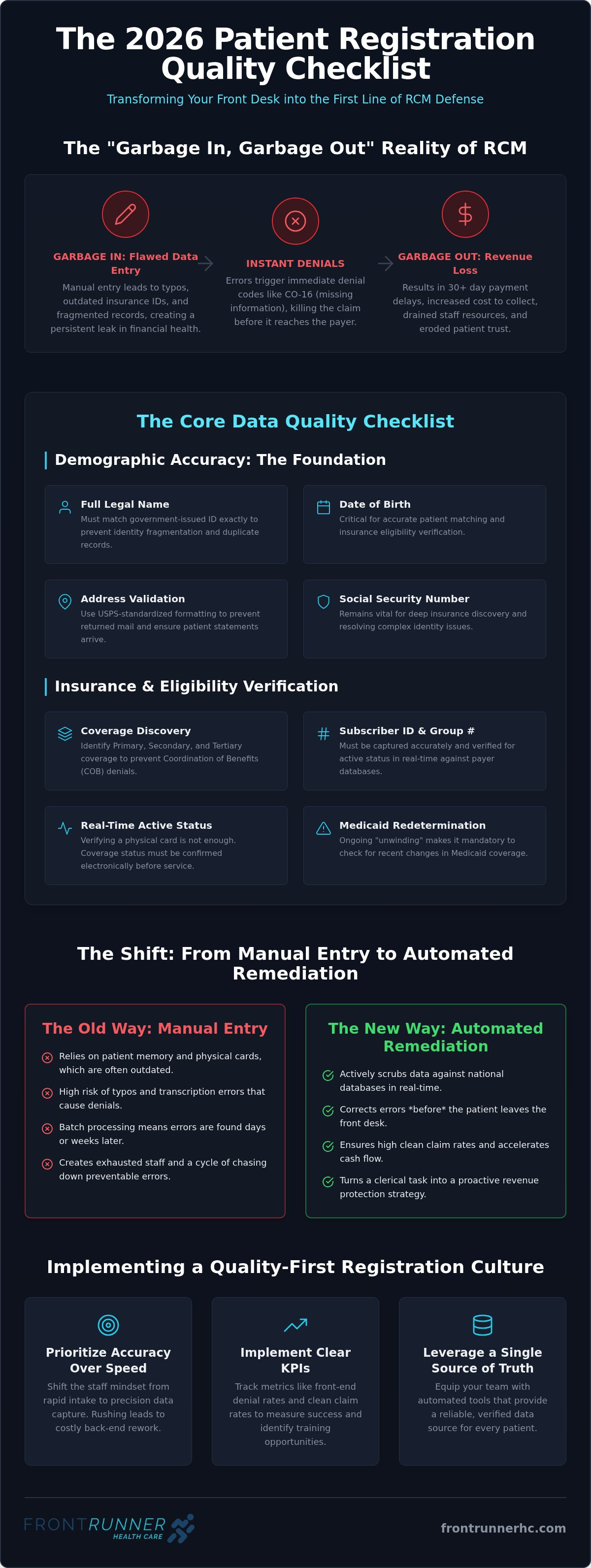
Registration data quality is the accurate capture of demographic and financial data to ensure seamless reimbursement. It's the bedrock of effective Revenue Cycle Management (RCM). Without it, the rest of the process falls apart. The industry operates on a "Garbage In, Garbage Out" reality. If a registrar enters a misspelled name or an incorrect policy number, the back-office team is already set up for failure. This isn't theoretical; it's financial. Errors at the front end trigger specific denial codes, such as CO-16, which signals that a claim lacks information. These are preventable mistakes that stall cash flow and drain resources.
The Cost of 'Good Enough' Data
Settling for "good enough" data creates a massive hidden tax on your operations. Every typo or missing digit requires manual correction, re-billing, and hours of staff time that could be spent on higher-value tasks. The impact on the patient experience is equally severe. When a patient receives an unexpected bill or a denial notice due to a registration error, trust erodes instantly. A single character mistake in a zip code or group number can easily lead to a 30-day payment delay. These delays compound. They create a bottleneck that affects the entire organization's liquidity and increases the cost to collect.
From Clerical Task to Revenue Strategy
To succeed in 2026, providers must shift their staff mindset from speed of intake to accuracy of data. High-volume clinics often prioritize moving patients through the lobby, but rushing leads to wreckage. Modern standards require real-time validation rather than old-fashioned batch processing. This is where patient registration workflow automation becomes essential. Instead of relying on a human to catch every nuance of a complex insurance card, automated systems scrub data against national databases instantly.
This shift turns a clerical task into a proactive revenue strategy. By integrating patient registration workflow automation, organizations ensure that every record is clean before the patient even leaves the waiting room. It replaces the "check the box" mentality with a rigorous data remediation process. You aren't just registering a patient; you're securing the financial integrity of the entire encounter. Precision at the front desk is the only way to eliminate the friction that typically happens at the back end.
The 2026 Patient Registration Data Quality Checklist
Standard EHR fields are often just empty containers. They don't prevent errors; they simply host them. To ensure financial health, your team needs a checklist that prioritizes real-time scrubbing against national databases. Relying on a patient's memory or a scanned insurance card is a gamble you can't afford to take. By implementing patient registration workflow automation, you move from passive data entry to active data remediation. This ensures that every piece of information is verified before the claim is even generated.
Demographic Accuracy: The Foundation
Accuracy begins with the basics. Full Legal Name and Date of Birth must match government-issued IDs exactly to prevent identity fragmentation. Address validation is where many providers stumble. Using USPS-standardized formatting is critical to prevent mail returns and ensure patient statements actually arrive. While some organizations hesitate to ask for Social Security Numbers (SSN), capturing them remains vital for deep insurance discovery. Following best practices for patient registries ensures that your data collection is uniform and systematic, which significantly reduces the risk of creating duplicate records that haunt your HIM department for years.
Insurance Discovery and Eligibility Fields
Verifying a physical card is no longer enough in a complex payer environment. You must identify Primary, Secondary, and even Tertiary coverage to prevent coordination of benefits (COB) denials. Subscriber IDs and Group numbers must be verified for active status in real-time. With the ongoing impacts of Medicaid redetermination, checking for recent coverage changes is mandatory. This is where automated patient data verification excels. It uncovers active policies that patients might not even know they have, protecting your revenue from "unwinding" surprises. Modern patient registration workflow automation tools turn these complex checks into a seamless, background process.
Financial Disposition and Responsibility
Determining a patient's financial disposition before service is a strategic necessity. Many "self-pay" patients are actually "hidden insurance" patients who simply lost track of a secondary policy or a recent change in coverage. Verifying COB ensures the correct payer order from day one. If you want to stop the leak of uncompensated care, you need a system that handles the heavy lifting of data remediation automatically. You can leverage PatientRemedi to scrub demographic and insurance data simultaneously, ensuring your staff spends less time on data entry and more time on patient care.
Common Pitfalls in Patient Demographic Verification
Patients don't visit your facility to update their administrative records; they visit to get well. This focus on clinical outcomes often means that personal details like a recent move or a name change after marriage are the last things on their minds during intake. When a registrar asks, "Is your information still the same?" most patients reflexively answer "yes" without a second thought. This simple interaction is where patient registration workflow automation becomes a necessity. Without a system to cross-reference these claims against external databases, your organization inherits stale, inaccurate data that will eventually trigger a denial.
One of the most damaging shortcuts in the industry is the "defaulting" of fields. Under the pressure of a crowded waiting room, staff may enter placeholders like "123 Main St" or "000-00-0000" just to bypass mandatory EHR screens and move to the next patient. These shortcuts are budget killers. Poor patient registration data quality leads to fragmented records that are nearly impossible to reconcile later. By the time the billing department realizes the address is fake, the window for clean claim submission has often closed.
The Duplicate Record Nightmare
Inaccurate data is the primary architect of duplicate identities within your Master Patient Index (MPI). When a patient’s name is misspelled or an alias is used, the system creates a second record, effectively splitting the patient's history in two. This creates a clinical minefield. A physician looking at one record might miss critical information about allergies, current medications, or recent lab results stored in the other. Financially, this results in split billing and unrecoverable accounts, as your team struggles to piece together a coherent financial history for a single individual.
Outdated Insurance Information
Relying on the physical card in a patient's wallet is a high-risk strategy. Cards can be years out of date, and patients frequently present expired coverage simply because they haven't received a new one. This is especially prevalent with the "Self-Pay" trap. Many patients who claim to have no insurance actually have active Medicaid or a secondary policy they've forgotten. Real-time insurance discovery is the only way to uncover this active primary coverage. By utilizing patient registration workflow automation, your team can move beyond the "card in the wallet" and identify the correct payer before the patient even enters the exam room. This proactive remediation prevents the uncompensated care that often stems from administrative oversights.
Automating the Workflow: Manual Entry vs. Data Remediation
Manual registration is a relic of a slower era. Even organizations that have transitioned to digital intake forms often find themselves stuck in a "digital paper" trap. These forms are only half the battle. If your intake process simply digitizes a patient's errors without verifying them, you haven't solved the problem; you've just made it move faster. True patient registration workflow automation goes beyond data collection. It moves into the territory of data remediation, where every entry is cross-referenced against authoritative sources before it ever reaches your billing system.
The 2026 shift toward healthcare data remediation software represents a fundamental change in RCM strategy. Instead of asking staff to be private investigators, automation identifies missing coverage that manual checks routinely miss. It uncovers secondary policies, identifies active Medicaid during redetermination cycles, and corrects address formatting in the background. This proactive approach ensures that the "first line of defense" is actually defended by technology, not just by the best efforts of a tired registrar.
Real-Time Eligibility Check for Providers
Batch verification is a recipe for surprises. When you verify insurance in large groups days before an appointment, you miss the "unwinding" changes that happen in real-time. Modern workflows require instant, point-of-service checks. This is achieved through robust API integrations between your EHR and advanced insurance discovery tools. Real-time data reduces front-end billing errors significantly by flagging inactive policies the moment a patient checks in. It provides the clarity needed to discuss financial responsibility immediately, rather than sending a confusing bill 60 days later.
The Role of AI in Data Scrubbing
Machine learning has transformed the way we handle administrative "noise." AI tools now predict which data points are likely incorrect based on historical patterns and demographic shifts. This allows for the automated "cleanup" of accounts receivable before they ever become denials. By removing repetitive data entry tasks, you don't just improve accuracy; you directly reduce staff burnout. Your team can focus on the patient in front of them while the software handles the invisible heavy lifting of data integrity. Precision becomes the default setting of your organization, not an occasional achievement.
If you are ready to stop chasing denials and start preventing them, you can implement PatientRemedi to automate your registration data scrubbing today.
Implementing a Quality-First Registration Culture
Culture isn't built on slogans; it's built on measurable standards. For too long, registration teams have been judged primarily on speed. In 2026, the metric that truly matters is the clean claim rate. This shift requires a tight, transparent feedback loop between the billing office and the front desk. When a claim is denied due to a front-end error, the registrar needs to know exactly what went wrong. This isn't about assigning blame. It's about closing the gap between intake and reimbursement. Integrating patient registration workflow automation provides the infrastructure for this culture, turning every desk into a center for data integrity.
Technology provides the "single source of truth" that manual processes simply cannot match. By leveraging PatientRemedi, organizations can automate the scrubbing of demographic and insurance data simultaneously. This doesn't slow down the intake process; it accelerates it by removing the need for manual verification and phone calls to payers. The long-term ROI is undeniable. Every dollar invested in patient registration workflow automation saves multiples in reduced denial management and manual rework costs.
Training and Accountability
Empowerment comes from having the right tools. Instead of registrars guessing which address is correct or which insurance policy is active, give them the ability to fix errors before the patient leaves the lobby. Set clear targets for clean claim rates at the individual level to foster a sense of ownership. Use regular data quality audits to identify specific training gaps rather than issuing broad, ineffective mandates. When staff see how their accuracy directly impacts the organization’s financial health, they move from being data entry clerks to being revenue cycle protectors.
The Final Safety Net
Even with the best training and culture, some coverage remains hidden or complex. This is why insurance discovery software serves as a critical final check. It acts as a safety net for the entire RCM process, uncovering active policies that even the most diligent staff might miss during a busy shift. It ensures that "self-pay" patients are thoroughly screened for active coverage they may have forgotten or recently acquired. By combining a quality-first culture with advanced automation, you ensure that your organization’s financial health is never left to chance or human error.
Securing Your Revenue Cycle at the Source
The era of clerical guesswork is over. Registration is no longer just an administrative task; it is your most powerful strategic lever for long-term financial stability. We've explored how a rigorous 2026 checklist and a definitive shift toward data remediation can stop the cycle of "garbage in, garbage out" before it starts. By replacing error-prone manual entry with patient registration workflow automation, you ensure that every patient record is clean, billable, and accurate from the first point of contact.
Precision at the front desk protects your bottom line and your staff's morale. You can optimize your registration workflow with PatientRemedi to achieve real-time demographic scrubbing and uncover hidden insurance for self-pay accounts. This proactive approach allows organizations to reduce front-end denials by up to 30% while accelerating patient throughput. It's time to move beyond the frustration of fragmented records and insurance surprises. You have the tools to turn administrative chaos into operational excellence and build a more resilient healthcare organization today.
Frequently Asked Questions
What is the most common error in patient registration?
The most common error is providing incorrect or outdated insurance information, often involving an expired card or a missed secondary policy. Typographical errors in names and addresses are also frequent, leading to identity fragmentation. These small mistakes create a ripple effect that stalls the entire revenue cycle. Addressing these challenges requires a shift toward real-time validation to catch errors at the source rather than during the billing cycle.
How does patient registration data quality affect claim denials?
Poor data quality is the leading cause of front-end denials, such as CO-16 or eligibility rejections. When demographic or insurance details are inaccurate, the claim's doomed before it leaves the office. Implementing patient registration workflow automation ensures that data's scrubbed against national databases. This significantly reduces the likelihood of these preventable financial setbacks and helps your team maintain a high clean claim rate without manual rework.
What are the mandatory fields for patient registration in 2026?
Beyond basic demographics like full legal name and date of birth, 2026 standards require verified Social Security Numbers for insurance discovery and USPS-standardized addresses. Financial responsibility fields, including primary and secondary insurance IDs, group numbers, and Coordination of Benefits status, are also mandatory. These fields must be validated in real-time to ensure they reflect the patient's current, active status and prevent downstream billing friction.
Can automated software find insurance the patient didn't provide?
Yes, advanced insurance discovery tools search national databases to uncover active policies that patients may not even know they have. This is common with secondary coverage or Medicaid benefits that were recently reinstated. This process helps providers identify the correct primary payer and reduces the number of accounts incorrectly categorized as self-pay. It's a critical step in protecting your organization's revenue from uncompensated care.
What is the difference between eligibility verification and insurance discovery?
Eligibility verification confirms that a specific, known insurance policy is currently active and covers the intended services. Insurance discovery's a broader search used to find coverage when a patient claims to be self-pay. Both are essential components of patient registration workflow automation. They work together to ensure every patient encounter's backed by valid, billable coverage, preventing the loss of revenue that occurs when active policies go undetected.
How often should patient demographic data be verified?
Demographic data should be verified at every single patient encounter. Relying on the question "is your information the same?" is a high-risk practice because patients often forget to mention recent moves or name changes. Real-time scrubbing tools allow for a quick, background check during check-in. This ensures that your Master Patient Index remains accurate and prevents the creation of costly duplicate records that complicate clinical care.
Is manual data entry still necessary with modern EHR systems?
While EHRs store data, they don't inherently verify its accuracy. Manual entry's still common but should be minimized through automated data remediation. Modern systems use API integrations to pull and verify information from external sources, reducing the burden on staff. This shift allows registrars to focus on patient interaction while the software handles the technical heavy lifting of data integrity, ensuring that every record's accurate before billing.
How does Medicaid redetermination impact registration data quality?
Medicaid redetermination creates a volatile environment where patient coverage can change overnight. Without specialized tools like RedeterminationAssist, providers often miss these unwinding events, leading to unexpected denials. Maintaining data quality during this period requires constant monitoring and real-time eligibility checks. This ensures that patients're billed correctly and that alternative coverage's identified if Medicaid's lost, protecting your organization from the financial impact of sudden coverage gaps.


Comments